CSI

Author: joseph

  • Direct Mail Printing in Alexandria: Response & ROI Guide

    Direct Mail Printing in Alexandria: Response & ROI Guide

    Direct Mail Printing in Alexandria: Response & ROI Guide

    Direct mail printing in Alexandria works when a well designed piece is printed sharply, personalized to the right list, and dropped into a mailbox that a Washington DC metro household actually checks. That is the whole game. A printed postcard, brochure, or catalog still lands in a physical space that a screen never occupies, and the data shows people are reading it. This guide covers what direct mail delivers today, which formats to run, how to get the piece opened, and how to plan a campaign you can measure, using first party detail from our own shop in Alexandria and current figures from the U.S. Postal Service and the Association of National Advertisers.

    Key Takeaways

    • Advertising mail is now 62% of everything a U.S. household receives, so a printed piece competes in a channel people still open.
    • The average direct mail response rate is 4.4%, and campaigns mailed to a house list of existing customers return the most of any paid channel the ANA measures.
    • List quality drives results more than any other factor: house lists respond at 5% to 9%, prospect lists at 2% to 4.4%.
    • Pairing a mailer with a digital preview and a trackable response path (QR code, unique URL, or offer code) turns direct mail into a measurable channel.
    • Printing and mailing locally in Alexandria keeps proofs fast, turnaround short, and the whole job under one roof.

    What is direct mail printing, and why does it still work in the DC metro?

    Advertising mail now makes up 62% of everything a U.S. household receives, up from 59% in 2010, according to the USPS Household Diary Study data analyzed by Brookings. In other words, the mailbox has quietly become a marketing channel more than a bill channel, and that shift matters for any Alexandria business trying to reach the Washington DC metro.

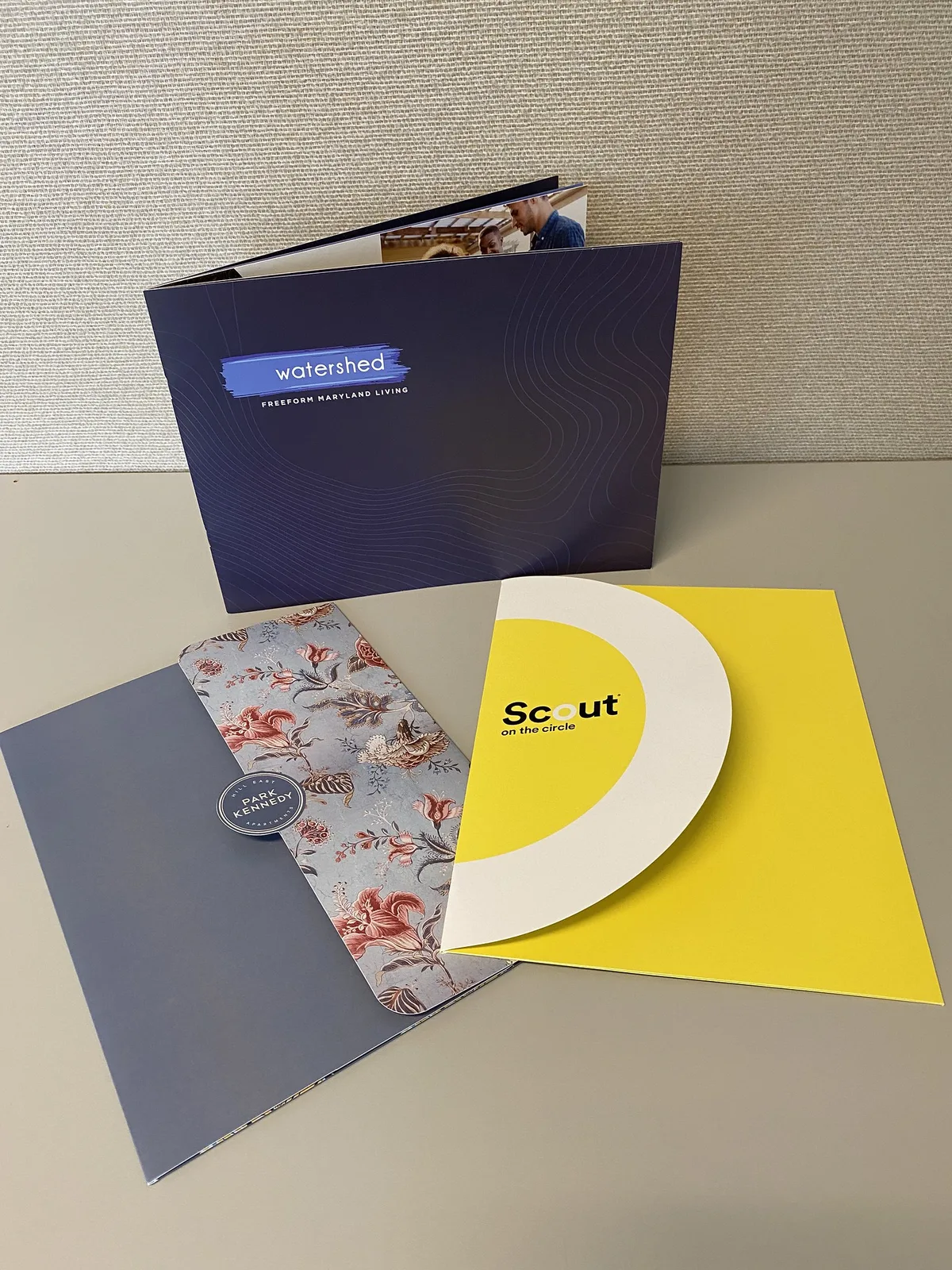
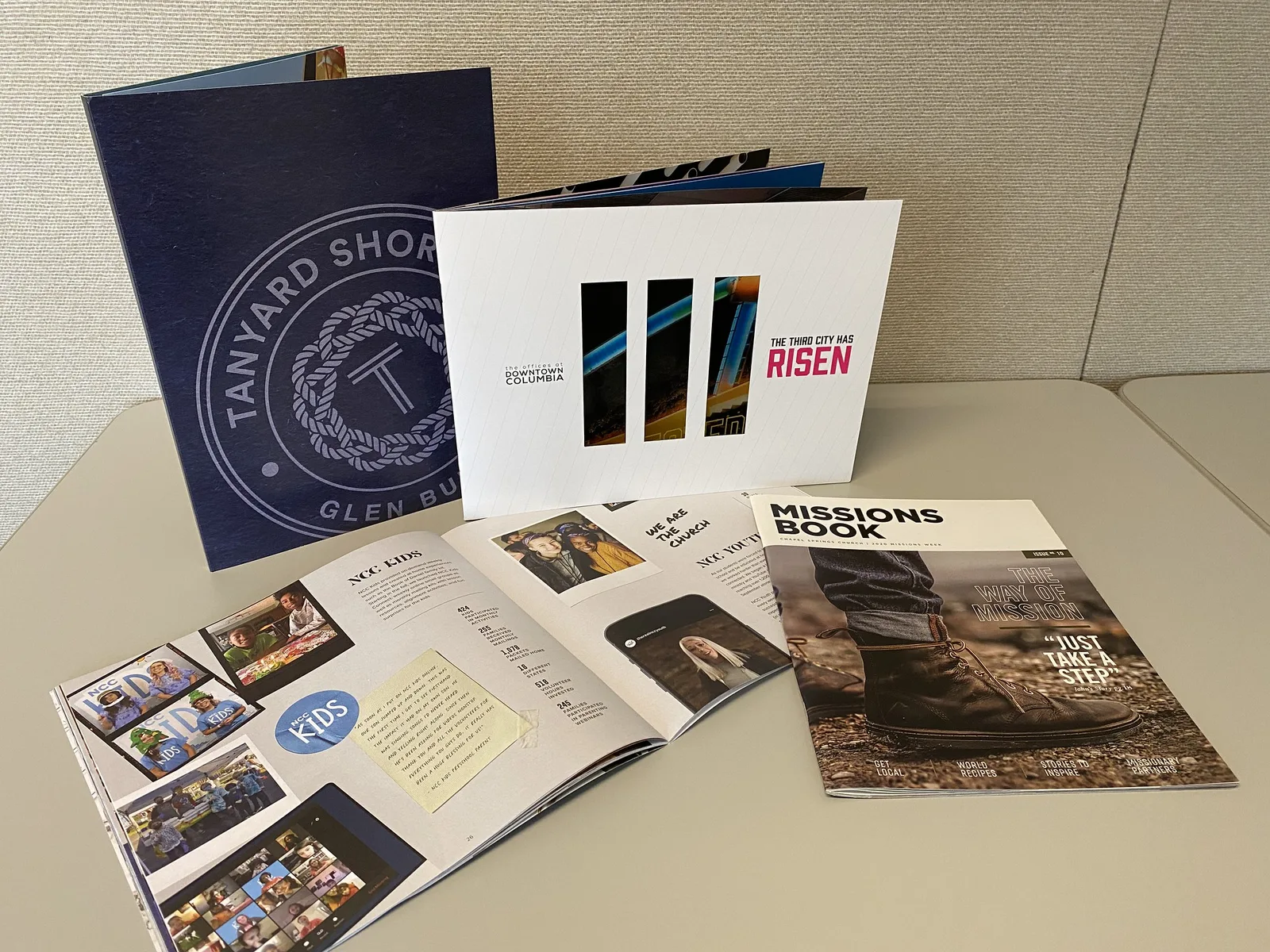
    Direct mail printing is the process of producing a physical marketing piece, a postcard, letter, brochure, self mailer, or catalog, and preparing it for delivery through the postal stream. For a local audience across Alexandria, Arlington, Fairfax, and into the District and suburban Maryland, that physical presence is the advantage. A printed piece sits on a counter, gets pinned to a board, or rides along in a bag. It does not disappear behind a spam filter or scroll past in a feed. CSI produces this small format work on an HP Indigo digital press, which gives offset quality output with the flexibility of on demand digital runs, so a short neighborhood test and a large regional drop come off the same platform. You can see the range of pieces on our small format digital printing page.

    How effective is direct mail for Alexandria businesses?

    The average direct mail response rate is 4.4%, and direct mail sent to an in house list returns 161%, the highest return of any paid marketing channel measured in the ANA 2025 Response Rate Report. Those numbers reframe a common assumption. Direct mail is not the nostalgic option, it is a performance channel that many businesses underuse because they compare its unit cost to email without comparing the response.

    The response gap is the point. A 4.4% response rate means roughly 44 replies for every 1,000 pieces mailed to the right audience, and that reply is often a phone call, a store visit, or a completed form rather than a passive open. For a service business, a restaurant, a museum, or a civic organization in the DC metro, a few dozen genuine responses from a targeted local drop can pay for the entire campaign. The lesson is not that direct mail beats digital, it is that the two work best together, with the printed piece driving the response and digital channels reinforcing it.

    What can you print and mail from Alexandria?

    Households received roughly 620 pieces of mail across the full year in 2025, per the same USPS Household Diary Study figures, which means your piece has to earn attention against everything else in the box. Format is the first lever. Different goals call for different pieces, and the right choice depends on your offer, your budget, and how much you need to say.

    FormatBest forNotes
    PostcardsLocal offers, event invites, grand openingsLow cost per piece, no envelope to open, fast to design
    Brochures and self mailersExplaining a service or menuMore room for detail while staying inside mail rates
    LettersPersonalized outreach and appealsFeels one to one, strong for house lists and donors
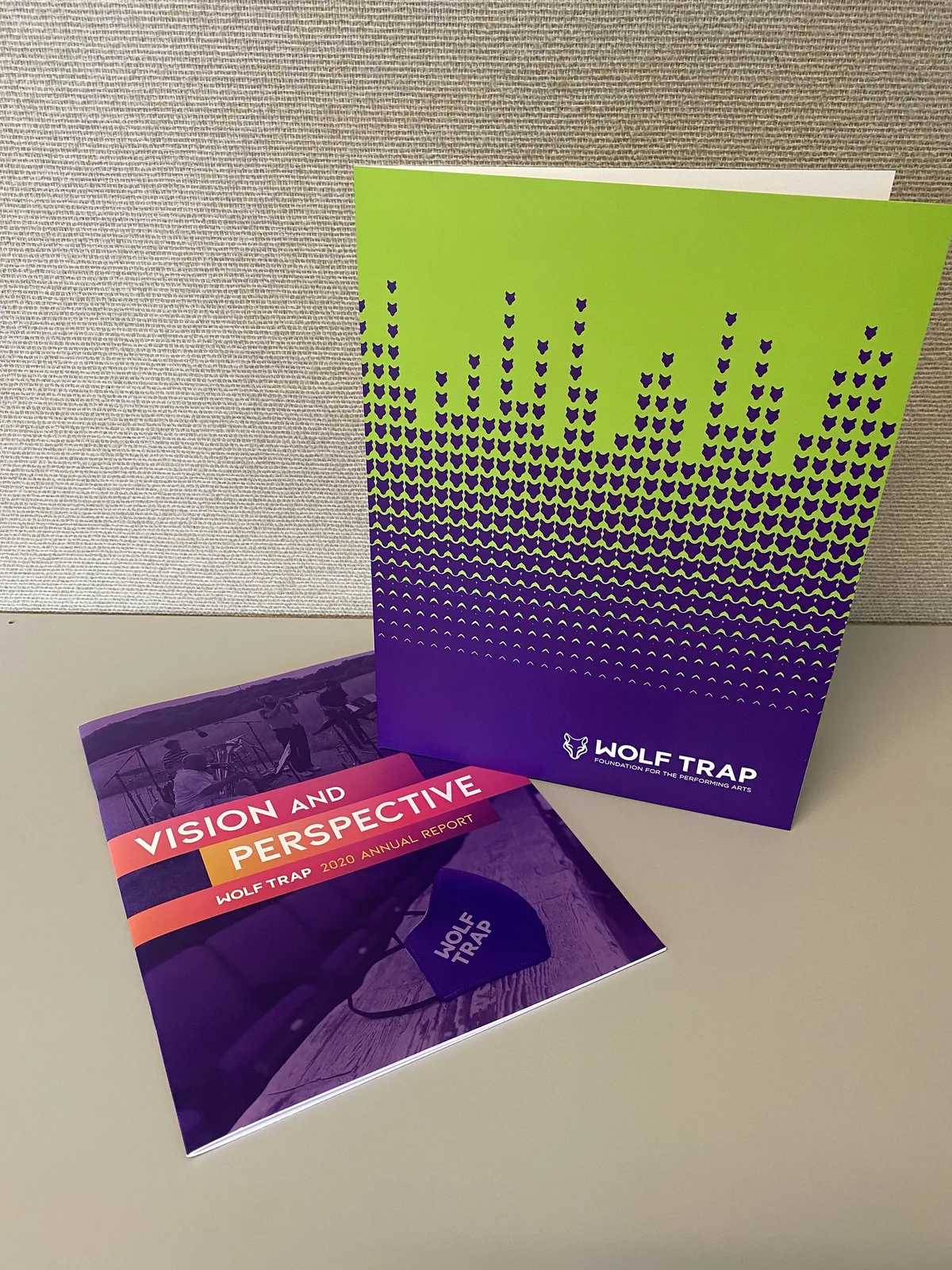
    Catalogs and annual reportsProduct ranges and member communicationsHigher production value, longer shelf life
    Event collateralPrograms, badges, credentials, invitationsTies a mailed invite to an on site experience

    Every one of these can carry variable data, meaning names, addresses, offers, and images that change from piece to piece so each recipient gets a version made for them. CSI handles short runs, long runs, and fast runs on the same digital platform, with most small format jobs completed same day or next day. If your campaign also needs banners, event graphics, or signage to match the mailer at a location, our full capabilities overview shows how the small format and large format digital printing sides connect.

    How do you make sure your mail actually gets opened?

    More than 74.8 million people were enrolled in USPS Informed Delivery as of May 2026, according to U.S. Postal Service Postal Facts, a free service that emails recipients a preview image of the mail arriving that day. That single fact should change how you plan a campaign, because a well designed mail piece now gets a digital impression before it is ever touched.

    Getting opened comes down to three things. First, design for the format: a postcard has to communicate in one glance, while a letter can slow the reader down. Second, integrate the digital preview by making the front of the piece legible and on brand so the emailed image earns a second look. Third, give people an obvious way to respond, whether that is a QR code, a short personalized URL, an offer code, or a simple phone number. Personalization through variable data raises open and response rates further, because a piece addressed to a person and referencing something relevant to them reads as a message rather than a flyer. The mechanics of print, list, and offer all point back to one goal, making the recipient feel the piece was meant for them.

    How do you plan and measure a direct mail campaign?

    The benchmarks marketers rely on come from the USPS Household Mail Survey, which samples about 5,200 households each year, as described by the U.S. Postal Service. Real sampling behind the numbers is a reminder that direct mail is a measurable discipline, not guesswork, and your own campaign should be built to be measured too.

    Start with the list, because it moves results more than anything else. House lists, your existing customers, past inquirers, and donors, respond at 5% to 9%, while cold prospect lists respond at 2% to 4.4%. Mail your own customers first, then expand to prospects once the offer is proven. Next, decide the offer and the single action you want, then design the piece around that one action. Add tracking before you print: a unique QR code, a campaign specific URL, or a coded response line tells you exactly how many replies each drop produced. Finally, test small and scale what works. A short local run through a same day or next day digital print lets you try two versions in Alexandria neighborhoods, read the response, and then commit budget to the winner across the wider DC metro.

    Why print your Alexandria direct mail with a local partner?

    CSI has printed for the region since 1976, when the company started as a small composition and typesetting shop, and today employs more than 80 people across the MD, DC, VA, and neighboring area from our facility in Alexandria, VA. In February 2026 CSI joined forces with Duggal Visual Solutions, a partnership that added digital and electronic signage and full media creation and management to the services we already ran, while the Alexandria operation continues independently for DC metro clients. You can read the full story on our company history page.

    Local matters for direct mail in practical ways. Proofs move faster when the shop is in your metro, turnaround is shorter, and the same team that prints your mailer can also produce matching event graphics, digital signage, and the large format pieces and professional installation a campaign often needs at a venue or storefront. Keeping print, personalization, and finishing under one roof reduces handoffs and the errors that come with them. When you are ready to scope a campaign, get in touch with our Alexandria team and we will help you match the format, list, and timeline to your goal.

    Frequently Asked Questions

    What is the average response rate for direct mail? The average direct mail response rate is 4.4% across industries, according to the ANA 2025 Response Rate Report. Campaigns mailed to a house list of existing customers respond higher, in the 5% to 9% range, while prospect lists respond at 2% to 4.4%. Your actual rate depends most on list quality, offer, and design.

    How much does direct mail printing in Alexandria cost? Cost depends on the format, quantity, paper, personalization, and postage class, so the honest answer is that it is quoted per project. A postcard mailed to a local list costs far less per piece than a printed catalog. The most useful first step is to define your audience size and goal, then request a quote so the price reflects your actual campaign rather than a generic rate.

    How fast can a direct mail campaign be printed? Most small format digital jobs at CSI are completed same day or next day, and the same platform handles short, long, and fast runs. Total campaign timing also depends on list preparation, proofing, and the mailing schedule, so building in time for one proof round keeps the drop on track.

    Can I personalize each mail piece? Yes. Variable data printing lets names, addresses, offers, and images change from piece to piece, so each recipient receives a version tailored to them. Personalized mail addressed to a specific person generally earns stronger open and response rates than a generic piece.

    Does direct mail still work alongside digital marketing? Yes, and it works best in tandem. With more than 74.8 million people enrolled in USPS Informed Delivery, a mailed piece now generates a digital preview before it arrives, and adding a QR code or personalized URL connects the printed piece directly to your website. The printed piece drives the response while digital channels reinforce it.
    Next
    Next

    Brochure Printing in Alexandria, VA | CSI Printing & Graphics

  • Brochure Printing in Alexandria, VA | CSI Printing & Graphics

    Brochure Printing in Alexandria, VA | CSI Printing & Graphics

    Brochure Printing in Alexandria, VA | CSI Printing & Graphics

    Brochure Printing in Alexandria, VA: A Local Business Guide to Print That Gets Read

    Brochure printing in Alexandria still gives a Washington DC metro business something no ad server can: a tangible piece a customer can hold, keep, and pass along. A well made brochure earns its keep at a trade show booth, inside a direct mail envelope, on a reception desk, and tucked into a sales folder. This guide explains why print keeps performing, what separates a strong brochure from a forgettable one, and how to choose the right print partner in Alexandria and the wider DC, Maryland, and Virginia market.

    Key Takeaways

    • Print still converts. Direct mail that uses printed pieces averages far higher response rates than email or social, according to the ANA Response Rate Report.
    • Print is more memorable. Neuromarketing research from Temple University and Canada Post shows physical print is easier to recall and takes less mental effort to process than digital.
    • Details decide. The best brochures pair sharp design with the right paper, finishing, and a local partner who can proof and produce quickly.
    • Brochures work in a system. In the DC metro, brochures work hardest when they connect to a larger visual program: event graphics, digital signage, large format, and vehicle graphics.
    • Local production matters. CSI Printing & Graphics prints small format work on an HP Indigo digital press in Alexandria, VA, with same-day and next-day turnaround on many jobs.

    Do printed brochures still work in a digital-first market?

    Yes, and the numbers back it up. The 2024 ANA Response Rate Report found direct mail response rates of 5% to 9% for house lists and 4% to 5% for prospect lists, while email averages about 1% and social media usually lands below 1%. A printed brochure does not fight a spam filter or vanish under a feed refresh. It sits on a desk. It gets picked up.

    Response is only half the story. That same reporting puts direct mail median return on investment at 112%, ahead of paid search at 93% and online display at 89%. For a local Alexandria business, a brochure is one of the few marketing pieces that does real work in more than one place: handed out at an event, mailed to a targeted list, left at a partner counter, and included in a quote packet. If you want a deeper checklist before you order, our brochure buyer's guide and our small format digital printing page walk through the formats and paper choices in more detail.

    Why are printed brochures easier to remember?

    Because paper is easier on the brain. Neuromarketing studies by Temple University's Fox School of Business, conducted with the U.S. Postal Service in 2015 and 2019, found that people remember physical ads more quickly and more confidently than digital ones, and that those stronger memories held across age groups. You can read the summary of that research on the USPS Delivers resource.

    Separate neuroscience research from Canada Post with True Impact found that print takes about 21% less cognitive effort to process than digital media, which is a big part of why it sticks. A brochure a prospect keeps on a desk keeps selling for days. A banner ad they scroll past is gone in a second. The practical takeaway is not print versus digital. It is print with digital: combining the two can lift overall response by 20% to 30%, so a brochure that echoes your website and email tends to outperform either channel alone.

    What makes a strong brochure, from design to press?

    A strong brochure starts with a clear job and ends with the right production choices. Decide the fold first. A bi-fold reads like a simple menu, a tri-fold is the classic mailer and rack piece, and a gate-fold gives you a wide reveal for a hero image. Then match paper to purpose. A heavier coated stock feels premium in the hand and holds color well, while an uncoated stock is easier to write on and reads as approachable.

    Production is where good design either survives or gets muddy. Build files at 300 dpi in CMYK, add bleed, and keep important text away from the trim edge. Color consistency is the detail people notice without knowing why, especially when a brochure sits next to your other printed pieces. CSI prints small format work on an HP Indigo digital press for offset-quality color, and offers finishing that changes how a piece feels, including laminating, binding, variable data printing, and specialty coatings. Variable data printing is worth calling out on its own: it swaps names, offers, or images on each copy, which turns a generic handout into a targeted mailer for an Every Door Direct Mail campaign.

    How to choose a brochure printing partner in Alexandria and the DC metro

    Look for a local shop that can proof, produce, and problem-solve without a long shipping delay. Speed is the reason many DC metro businesses print close to home: at CSI, many small format jobs ship the same day or the next day, which matters when an event date will not move. Ask a prospective printer four things: can you proof locally, can you help fix a file that is not print-ready, can you scale from a short run to a long run without changing the look, and can you handle the rest of my visual brand when I grow beyond brochures.

    That last question is where a full-service partner earns its place. CSI Printing & Graphics has printed for the DC region since 1976 and works out of 840 South Pickett Street in Alexandria, VA, serving clients across DC, Maryland, and Virginia. You can see the full range on the capabilities page, and when you are ready to price a job you can get in touch with the Alexandria team directly.

    Brochures as one piece of a bigger DC-metro visual program

    Brochures rarely work alone. The brands that get remembered keep one look across event graphics, digital signage, large format banners and wall murals, trade show displays, and vehicle graphics. When a prospect sees the same colors and message on your booth, your mailer, and your fleet, each touch reinforces the last. Fleet branding and fleet graphics carry that identity down the road, and your large format work sets the scene at the venue. A brochure then becomes the piece a visitor takes home, closing the loop between a physical experience and a follow-up call.

    CSI is built for that kind of connected program. In early 2026 the company joined forces with Duggal Visual Solutions, a partnership that added an expanded range of capabilities, including digital signage and full media creation, while CSI continues to run independently in the DC, Maryland, and Virginia metro. So the same partner who prints your brochures can also produce your vehicle graphics (the fleet-branding pieces some buyers still search for as vehicle wraps), your event graphics, and the large format signage that ties a campaign together. For many buyers this is what they mean when they search for commercial printing: one team that keeps a brand consistent across every printed and lit surface.

    Frequently asked questions

    How much does brochure printing cost in Alexandria, VA?

    Brochure cost depends on quantity, size, paper stock, and finishing. Short runs on a digital press are cost-effective for small businesses, while long runs lower the price per piece. The most accurate way to budget is to send your specs to a local shop and request a written quote.

    How fast can brochures be printed?

    Turnaround depends on the job. At CSI Printing & Graphics, many small format pieces ship the same day or the next day, while brochures that need laminating, binding, or specialty coatings take longer. Confirm timing with your printer when you request a quote.

    What file format should I send for brochure printing?

    Send a print-ready PDF built at 300 dpi in CMYK color with bleed and safe margins. If your file is not set up correctly, a local print partner can review it and help prepare it before it goes to press.

    Can brochures be personalized for a direct mail campaign?

    Yes. Variable data printing changes names, offers, or images on each piece, which makes brochures and mailers feel personal. This pairs well with targeted direct mail and Every Door Direct Mail campaigns across the DC metro.

    The bottom line for Alexandria businesses

    Printed brochures still earn their place because they are tangible, trusted, and easy to remember. Pair a clear design with the right paper and finishing, print with a local Alexandria partner who can move quickly, and connect that brochure to the rest of your visual brand. Do that, and a simple folded sheet becomes one of the hardest-working pieces in your marketing. When you are ready to plan a run, the CSI Printing & Graphics team in Alexandria is a phone call away at 703.205.0000.

    Previous
    Previous

    Direct Mail Printing in Alexandria: Response & ROI Guide

    Next
    Next

    Sign Installation in Northern Virginia: What Every Business Should Know First

  • Sign Installation in Northern Virginia: What Every Business Should Know First

    Sign Installation in Northern Virginia: What Every Business Should Know First

    Sign Installation in Northern Virginia: What Every Business Should Know First

    Sign Installation in Northern Virginia: What Every Business Should Know First

    A great sign fails if it goes up in the wrong place, at the wrong height, or without the right permit. In Northern Virginia, where Fairfax County, Arlington County and the City of Alexandria each run their own approval process, sign installation is as much a compliance job as a craft. This guide walks through what installation actually involves, when you need a permit, which codes apply, and how to choose a partner who can produce and mount the work correctly the first time.

    CSI Printing & Graphics is based at 840 South Pickett Street in Alexandria, Virginia, and has spent decades installing everything from storefront signage to large-scale event graphics across the DC, Maryland and Virginia region. The notes below reflect that first-hand experience alongside the published rules from each jurisdiction.

    Key takeaways

    • Most exterior signs in Northern Virginia need a permit before they go up. Fairfax County requires one for any sign that is constructed, erected, altered, refaced, relocated or expanded.
    • Arlington County and the City of Alexandria run their own separate approvals, so a sign that is legal in one jurisdiction may not clear the next.
    • Interior tactile signs must follow federal ADA placement rules: characters mounted 48 to 60 inches above the floor and located on the latch side of the door.
    • Signs are structures. In Fairfax County they must be installed to the Virginia Uniform Statewide Building Code, which is why anchoring and wind loading are not a DIY task.
    • A local partner that both produces and installs, and that knows each county's process, removes most of the risk and delay from a project.

    What does professional sign installation involve in Northern Virginia?

    In Fairfax County, a sign permit is required for any sign that will be "constructed, erected, altered, refaced, relocated, or expanded," which means installation begins long before anyone picks up a drill (Fairfax County Department of Planning and Development). Professional installation is the full process of getting an approved, code-compliant sign onto a building or site so it is safe, legible and built to last.

    That process usually starts with a site survey to confirm dimensions, wall construction and sight lines, followed by substrate selection, permit drawings, fabrication, and the physical mount with the correct anchors and hardware. Interior work adds its own steps for wall type, wayfinding logic and accessibility placement.

    CSI describes its own approach plainly: "We don't just print your graphics; we install them professionally to ensure maximum impact." That covers wall and window graphics, exterior and building signage, event and trade show setups, floor graphics and wayfinding, and large-scale banners. You can see the full scope on the CSI installation services page. The point is simple. Printing and mounting are two different disciplines, and the mount is where compliance and durability are won or lost.

    Do you need a permit to install a sign in Northern Virginia?

    Yes, in almost every case. Arlington County states that "a sign permit is required before any sign or advertising is erected, displayed, replaced, refaced, or its dimensions altered" (Arlington County Government). Fairfax County uses similar language and ties every installation back to Article 7 of its Zoning Ordinance (Fairfax County).

    The catch for businesses across the DC metro is that these are separate processes. A retailer with locations in Fairfax, Arlington and the City of Alexandria is dealing with three different applications, three sets of standards, and in some cases additional design review. Alexandria, where CSI is based, layers zoning review and, in its historic districts, Board of Architectural Review approval on top of the standard permit.

    This is where local knowledge pays for itself. An installer that files in these jurisdictions every week knows which drawings each reviewer expects, how long each queue runs, and where a proposed size or placement will trigger a rejection. Guessing at that from out of state is how projects slip by weeks.

    Which building codes and accessibility rules apply to installed signs?

    Interior tactile signs must place their characters between 48 inches minimum and 60 inches maximum above the finished floor, measured from the baseline of the lowest and highest tactile characters (United States Access Board, 2010 ADA Standards, section 703.4). The same standard requires a tactile sign at a door to sit "alongside the door at the latch side." An inch outside that window can fail an accessibility inspection, so placement precision is not optional.

    Exterior signs face a second layer of rules. Fairfax County requires that "all signs must be installed in accordance with approved sign permits, all Zoning Ordinance requirements, and the requirements of the Virginia Uniform Statewide Building Code" (Fairfax County). A sign is a structure. It has to resist wind load, stay anchored to its wall or footing, and, when illuminated, meet electrical requirements. These are the details that separate a professional install from a liability.

    A qualified installer treats accessibility and building code as part of the drawing set, not an afterthought. That is far cheaper than tearing down a finished sign because it sits two inches too high or was never engineered for the wind.

    What types of signs and graphics can be installed?

    Event graphics, digital signage and large format printing now make up the bulk of a modern install list, and CSI produces and mounts all three in house. On the large format side, that includes exterior and building signage, storefront branding, wall and window graphics, wayfinding and floor graphics, trade show displays and event backdrops, and large-scale banners for both indoor and outdoor use.

    Fleet work rounds out the picture. Vehicle graphics and fleet branding turn a company's trucks and vans into moving advertising, and CSI applies these as part of the same installation practice (the older term for the wrap-style version is vehicle wraps, which some buyers still search for). For teams that need a single supplier, the full capabilities list also covers small format digital work such as brochures, direct mail and credentials, so a campaign's print and signage can ship together.

    In early 2026 CSI joined forces with Duggal Visual Solutions, a partnership that added electronic and digital signage plus expanded media services while CSI continued to operate from its Alexandria facility. For a business planning a rollout, that means static and digital signage can be specified, produced and installed under one roof.

    How do you choose a sign installation partner in the DC metro?

    The strongest signal is simple: pick a partner that both produces and installs, because handoffs between a separate printer and a separate installer are where color, sizing and schedule problems creep in. CSI runs production and installation together and coordinates work "wherever you need them," which matters for any brand with locations spread across Northern Virginia, DC and Maryland.

    Look for three things. First, local fluency in the Fairfax, Arlington and Alexandria permit processes, so filings do not stall. Second, in-house project management, so a multi-site rollout stays on one timeline rather than fracturing across vendors. Third, genuine range, from a single storefront sign to a national program, since your needs will grow. CSI serves the VA, DC and MD region and also handles national and cross-border accounts, which gives a growing business room to scale without switching suppliers.

    If you are weighing a project, the practical next step is a conversation about scope, sites and deadlines. You can reach the CSI team through the get in touch page to start a site review.

    Frequently asked questions

    Do I need a permit to install a sign in Fairfax County?

    In most cases, yes. Fairfax County requires a sign permit "for any sign that will be constructed, erected, altered, refaced, relocated, or expanded," except where its Zoning Ordinance specifically exempts a minor sign (Fairfax County). Confirm your specific sign type before you fabricate anything.

    How high should an ADA-compliant sign be mounted?

    Tactile characters must sit 48 inches minimum and 60 inches maximum above the finished floor, measured from the baseline of the lowest and highest tactile characters, and a door sign belongs on the latch side (United States Access Board). Interior wayfinding and room identification signs are the usual place this rule applies.

    Can one company handle both sign production and installation?

    Yes, and it is usually the better route. CSI produces its graphics and signage and installs them as one service, which keeps color, sizing and scheduling under a single point of accountability rather than split between a printer and a separate crew.

    Does a Northern Virginia installer only work locally?

    Not necessarily. CSI is based in Alexandria and serves the DC, Maryland and Virginia region, but it also coordinates installations across multiple locations and handles national and cross-border accounts, so a business headquartered in Northern Virginia can roll out consistent signage in other markets too.

    Which Northern Virginia areas does CSI serve for sign installation?

    CSI works throughout Northern Virginia, including Alexandria, Arlington and Fairfax County, along with the wider Washington DC and Maryland metro. Because each jurisdiction runs its own permit process, local coverage is part of what keeps a project on schedule.

    Written by the team at CSI Printing & Graphics, Composition Systems Incorporated, 840 South Pickett Street, Alexandria, VA 22304.

    Previous
    Previous

    Brochure Printing in Alexandria, VA | CSI Printing & Graphics

    Next
    Next

    Brochure Printing in Washington, DC: A Buyer's Guide

  • Brochure Printing in Washington, DC: A Buyer's Guide

    Brochure Printing in Washington, DC: A Buyer's Guide

    Brochure Printing in Washington, DC: A Buyer's Guide

    Brochure Printing in Washington, DC: A Buyer's Guide

    Brochure printing in Washington, DC is the production of folded, multi-panel print pieces, from a simple tri-fold to a saddle-stitched booklet, that carry a marketing message a reader can hold, keep, and act on. The finished piece you actually want comes down to five choices: the fold, the paper stock, the finishing, the color accuracy, and the turnaround. Get those right and a brochure earns attention across a conference table or in the mail. Get them wrong and it reads as an afterthought.

    Here is the situation most buyers are in. You are a marketing lead, an event planner, or an office manager staring at a deadline. The regional sales meeting is in nine days. The association conference opens next week. The new location needs a leave-behind for walk-in traffic. You need brochures that look like the brand invested in them, and you need them on time. This guide walks through every decision that changes the result, in plain terms, so you can order with confidence.

    Key Takeaways

    • Five choices decide a brochure's outcome: fold, paper stock, finishing, color accuracy, and turnaround.
    • Print still works. A U.S. Postal Service neuroscience study found people spend more time with physical ads and remember them better than digital.
    • The tri-fold is the workhorse, but the right fold depends on how much you need to say and how you want it read.
    • Send a print-ready PDF in CMYK with a 0.125 inch bleed to keep your job moving and your color predictable.
    • For DC-metro campaigns, a local printer that runs file, press, and finishing under one roof protects both your timeline and your brand.

    What brochure printing includes, and why the details decide the outcome

    Brochure printing covers a wide range, from a single-fold flyer to a multi-page booklet, and every choice shifts cost, feel, and how fast the job runs. A brochure is defined by its panels. A flat sheet folded once creates four panels. Folded twice, it creates six. Add pages and stitching and you have a booklet. Each format changes how much you can say and how the reader moves through it.

    The other variables are paper weight, surface coating, and finishing such as scoring, laminating, or binding. None of this is decoration. A heavier cover stock and a clean fold signal that the organization behind the brochure is serious. CSI produces this work through its small-format digital printing line, which handles brochures, flyers, event collateral, business cards, and direct mail. The rest of this guide breaks down each decision so you know what to ask for.

    Why printed brochures still move buyers in a digital city

    Print earns attention that screens do not. In a neuroscience study the U.S. Postal Service Office of Inspector General ran with Temple University's Center for Neural Decision Making, participants spent more time with physical ads and remembered them better, and physical media triggered activity in the ventral striatum, the region of the brain tied to value and desirability, which can signal stronger intent to buy (USPS OIG). A week later, people recalled the printed pieces more quickly and confidently than the digital ones.

    That matters more in Washington, not less. This is a convention and business-travel town. Destination DC reported that more than 27 million people visited the capital in 2024, spending a record $11.4 billion (Destination DC). Trade shows, association meetings, and briefings fill the calendar, and a brochure is often the one thing a prospect carries out of the room. A screen closes when the meeting ends. A well-made brochure goes back to the office.

    The folds that fit your message

    The fold is your first structural decision, and it should follow the content, not the other way around. A short pitch wants fewer panels. A detailed service menu or a step-by-step process wants more. Here is how the common formats compare.

    Fold typePanelsBest for
    Single (bi-fold)4A focused message, a program, a simple menu
    Tri-fold (letter fold)6The all-purpose brochure: services, overview, contact
    Z-fold6Sequential steps or a timeline the reader follows in order
    Gate fold6A reveal moment, a hero image, a premium feel
    Booklet (saddle-stitched)8 or moreCatalogs, annual reports, deep product lines

    The tri-fold is the workhorse for a reason. It fits a standard rack, mails in a standard envelope, and gives you six panels to open, explain, and close. Reach for a Z-fold when order matters and a booklet when you simply have more to show.

    Paper stock and finishing that make a brochure feel premium

    Paper is the first thing a reader feels, and it sets expectations before a single word is read. Two variables carry most of the weight: stock and coating. Text-weight stock folds easily and suits high-volume handouts. Heavier cover stock feels substantial and holds up in a rack or a mailbox. For coatings, gloss makes photography pop, matte reads as understated and modern, and a silk or satin finish sits between the two.

    Finishing is where a good brochure becomes a memorable one. A soft-touch laminate adds a velvety feel that makes a piece hard to put down. Spot gloss can highlight a logo against a matte field. Scoring before folding keeps the crease clean so the panels do not crack, which matters on heavier stock and on any brochure with a solid ink color across the fold. CSI adds finishing options such as laminating and binding in house, so the piece is complete when it leaves the building rather than shipped out for a separate step.

    Color accuracy and the press that produces it

    Color consistency is what makes a campaign look like one brand instead of three. CSI prints small-format work on an HP Indigo digital press, which delivers offset-quality color with the flexibility of on-demand digital production. That combination is the point. You get the crisp, saturated result buyers expect from premium print, without the setup cost and minimums that traditional offset requires on shorter runs.

    The practical takeaway for buyers is simple. Build files in CMYK rather than RGB, because print reproduces color with ink, not light, and colors that glow on a monitor can shift on paper. If your brand relies on an exact color, ask for a proof and reference your brand color values. A short conversation up front prevents a reprint later. When your brochure needs to match a banner or a booth graphic, the same shop can carry that color across formats, from the handout to large format printing.

    Turnaround times for brochure printing in Washington, DC

    Speed is often the deciding factor, and it is where a local partner earns its keep. CSI offers same-day or next-day turnaround on standard small-format digital work, which covers most brochures. That window assumes a print-ready file and a standard stock. Custom finishing, unusual sizes, or booklets with binding take longer, and rush timing is easier to protect when the printer is a short drive away rather than a shipping label.

    The DC calendar rewards planning. Conventions and association meetings cluster around predictable dates, and print demand spikes right before them. Send your file as early as you can, confirm the fold and stock in writing, and ask about the cutoff time for same-day work. A printer that runs the press in house can quote a realistic timeline instead of a hopeful one.

    How to prepare a print-ready brochure file

    A clean file is the single fastest way to protect your deadline. Files that arrive print-ready move straight to press. Files that need fixes wait in a queue. Use this checklist before you send anything.

    • Export a high-resolution PDF, ideally to a PDF/X standard, with all fonts embedded or outlined.
    • Set images to 300 dpi at final print size so nothing looks soft.
    • Build the document in CMYK, not RGB, and flag any spot or brand colors.
    • Add a 0.125 inch bleed on every edge, and keep important text at least 0.125 inch inside the trim.
    • Set up the panels correctly for the fold. On a tri-fold, the panel that tucks inside is slightly narrower so it does not buckle.

    If you are unsure about the panel math or the bleed, send the working file and ask. A printer would rather adjust a template than reprint a job. You can see the full range of what a shop can prepare and produce on the CSI capabilities page.

    Choosing a brochure printer in the DC metro

    Choose a printer that owns the whole job, from the file to the fold to the finish. Printing is a real skilled trade, not a vending machine. The U.S. Bureau of Labor Statistics counts roughly 339,000 people working across about 27,000 printing establishments nationwide (BLS), and the gap between a careful shop and a careless one shows up in the crease, the color, and the deadline.

    Location is a practical advantage, not a sentimental one. A local partner means proofs you can approve in person, pickup instead of transit time, and one team accountable when the meeting cannot move. CSI has printed and installed graphics across the Washington region for more than 30 years from its facility at 840 South Pickett Street in Alexandria, Virginia, serving clients throughout DC, Virginia, and Maryland. The same team that prints your brochures also handles large format work and professional installation, so a single campaign, from the leave-behind to the booth to the wall graphic, stays consistent and on schedule.

    Frequently Asked Questions

    How much does brochure printing cost in Washington, DC?

    Price depends on quantity, paper stock, fold, and finishing, so the honest answer is that it varies. A short run on premium stock with laminate costs more per piece than a large run on standard text stock. The fastest way to a real number is to share your quantity, size, fold, and stock and request a quote.

    What is the most popular brochure fold?

    The tri-fold, also called a letter fold. It gives you six panels, fits a standard rack and a standard envelope, and works for almost any service overview or event handout.

    Can I get brochures printed same day in Washington, DC?

    Often, yes. CSI offers same-day or next-day turnaround on standard small-format digital jobs when the file is print-ready. Complex finishing or booklet binding needs more lead time, so confirm the cutoff when you send the file.

    What file format should I send for printing?

    A print-ready PDF built in CMYK, with a 0.125 inch bleed, embedded fonts, and images at 300 dpi. If you can only export the working file, send it and ask the printer to prepare it.

    Can one printer handle brochures and my event graphics too?

    Yes. Beyond brochures, CSI produces event collateral, banners, large format graphics, and signage, and provides installation, so the materials for a single event or campaign match and arrive together.

    Put your next brochure in good hands

    A brochure is a small thing that does a large job. It is the piece a prospect keeps, the leave-behind that outlasts the meeting, and the physical proof that a brand pays attention to detail. Decide the fold, choose the stock, prepare a clean file, and give a capable local shop enough lead time, and the result will look and feel like the brand meant it.

    When you are ready to print brochures in Washington, DC, get in touch with CSI at 703.205.0000 or CSI@CSI2.COM. Share your deadline and your files, and the team will handle the rest.

    Written by the CSI Printing & Graphics team, Alexandria, Virginia.

    Previous
    Previous

    Sign Installation in Northern Virginia: What Every Business Should Know First

    Next
    Next

    Banners in Washington, DC: Materials, Sizes, and Permits

  • Banners in Washington, DC: Materials, Sizes, and Permits

    Banners in Washington, DC: Materials, Sizes, and Permits

    Banners in Washington, DC: Materials, Sizes, and Permits

    Banners in Washington, DC: Materials, Sizes, and Permits

    Banners are still one of the fastest, highest-impact ways to put a message in front of people across Washington, DC and the surrounding Maryland and Virginia suburbs. The right banner comes down to three decisions: the material (vinyl, mesh, or dye-sublimated fabric), the size and finishing, and whether your location needs a city sign or public space permit. This guide walks through each choice using the presses and materials CSI runs in-house in Alexandria, VA, so you can order a banner for Washington, DC that prints sharp, survives the weather, and goes up without a permit surprise.

    Key Takeaways

    • Match the material to the location: heavyweight vinyl for outdoor durability, mesh for windy or elevated installs, and dye-sublimated fabric for indoor branding and events.
    • In the District, a permit is required to erect or replace an exterior sign, and a separate public space permit is needed to hang a banner over a sidewalk or street.
    • Grand-format presses handle banners up to 196 inches wide, so building banners, multi-panel graphics, and pole banners are all on the table.
    • Out-of-home advertising earns some of the highest recall in media, which is why a well-placed banner keeps paying off long after install.
    • Finishing (grommets, pole pockets, reinforced hems, double-sided printing) matters as much as the print, so choose it based on how the banner will hang.

    Which banner material is right for your project?

    Start with the material, because it decides how long the banner lasts and where it can safely hang. CSI prints banners on presses that handle heavyweight 13 oz and 15 oz outdoor vinyl, 10 oz mesh, and dye-sublimated soft-weave fabric up to 126 inches wide, so the material is a genuine choice rather than a default.

    Three materials cover almost every Washington, DC job:

    • Vinyl is waterproof and tear-resistant, which makes it the workhorse for outdoor advertising, storefront promotions, and special events. Heavyweight vinyl holds color and shrugs off rain and sun.
    • Mesh is a perforated vinyl that lets wind pass through the weave instead of catching it like a sail. That makes it the right call for construction fences, elevated installs, and any windy site where a solid banner would billow or tear.
    • Fabric is dye-sublimated for rich, saturated color that stays crisp, and it is lightweight, wrinkle-free, and reusable. It is the premium look for indoor branding, retail displays, and event backdrops.

    If you are weighing options for a specific space, our banner printing and large format printing pages show the finishes and sizes we produce, and our dye-sublimated fabric displays page covers soft signage and step-and-repeat backdrops in more detail.

    Do banners actually get people to act?

    The data on out-of-home media is strong. In a 2025 study from The Harris Poll and the Out of Home Advertising Association, 71% of consumers recalled out-of-home ads for sit-down and fine dining restaurants, and 86% reported taking action after seeing them. Personal care ads landed nearly as high, with 70% recall and 83% of adults taking some form of action.

    That recall is the whole argument for a physical banner. A banner outside a DC restaurant, gallery opening, or retail storefront keeps working every hour it is up, with no per-click cost and no ad account to manage. For the museums, restaurants, and civic organizations CSI works with across the DC metro, a single well-placed banner often outperforms weeks of paid digital impressions because it reaches people who are already on the sidewalk in front of the door.

    Do you need a permit for a banner in Washington, DC?

    Yes, in most cases. In the District of Columbia, a permit is required to erect or replace an exterior sign, and the application must include architectural plans showing the sign's dimensions and elevations along with a Certificate of Occupancy for the space, according to the DC Department of Buildings. Ground signs also require a surveyor's plat showing the location.

    There is a second layer for anything that hangs over public property. If a banner will occupy public space, such as a sidewalk, tree box, or the area over a street, you also apply for a public space permit through the District Department of Transportation. Rules differ across the line in Arlington, Alexandria, and the Maryland suburbs, so confirm the local requirement before you print. A team that installs across the DMV every week can flag this early, which is one reason professional installation is worth building into the project from the start rather than after the banner is made.

    How big can a banner be, and how fast can it be made?

    Size is rarely the constraint. CSI's Durst Rho 512r+ grand-format press prints up to 196 inches wide at up to 4,150 square feet per hour, which is what makes oversized building banners, multi-panel graphics, and rush event work practical on a real deadline. For rigid and roll work, the shop runs a mix of LED-UV flatbed and dye-sublimation presses, detailed on the in-house press capabilities page.

    Finishing is where a banner earns its durability. Choose it based on how the piece will hang:

    • Grommets for quick zip-tie or bungee mounting on fences and railings.
    • Pole pockets for pole banners, street signage, and hanging backdrops.
    • Reinforced hems on every edge so wind load does not tear the material.
    • Double-sided printing for banners that will be seen from both directions.

    Building banners, pole banners, and street signage all pull from the same large format printing line, so a citywide campaign can stay visually consistent from a storefront sign to a four-story building banner.

    Banners for trade shows and events in Washington, DC

    Live events are back. Trade show attendance has nearly returned to pre-pandemic strength, with attendee numbers only 3.7% below second-quarter 2019 levels, according to the Center for Exhibition Industry Research. Washington, DC is one of the busiest convention markets in the country, anchored by the Walter E. Washington Convention Center and a steady calendar of association meetings, so exhibitors here compete for attention on a crowded floor.

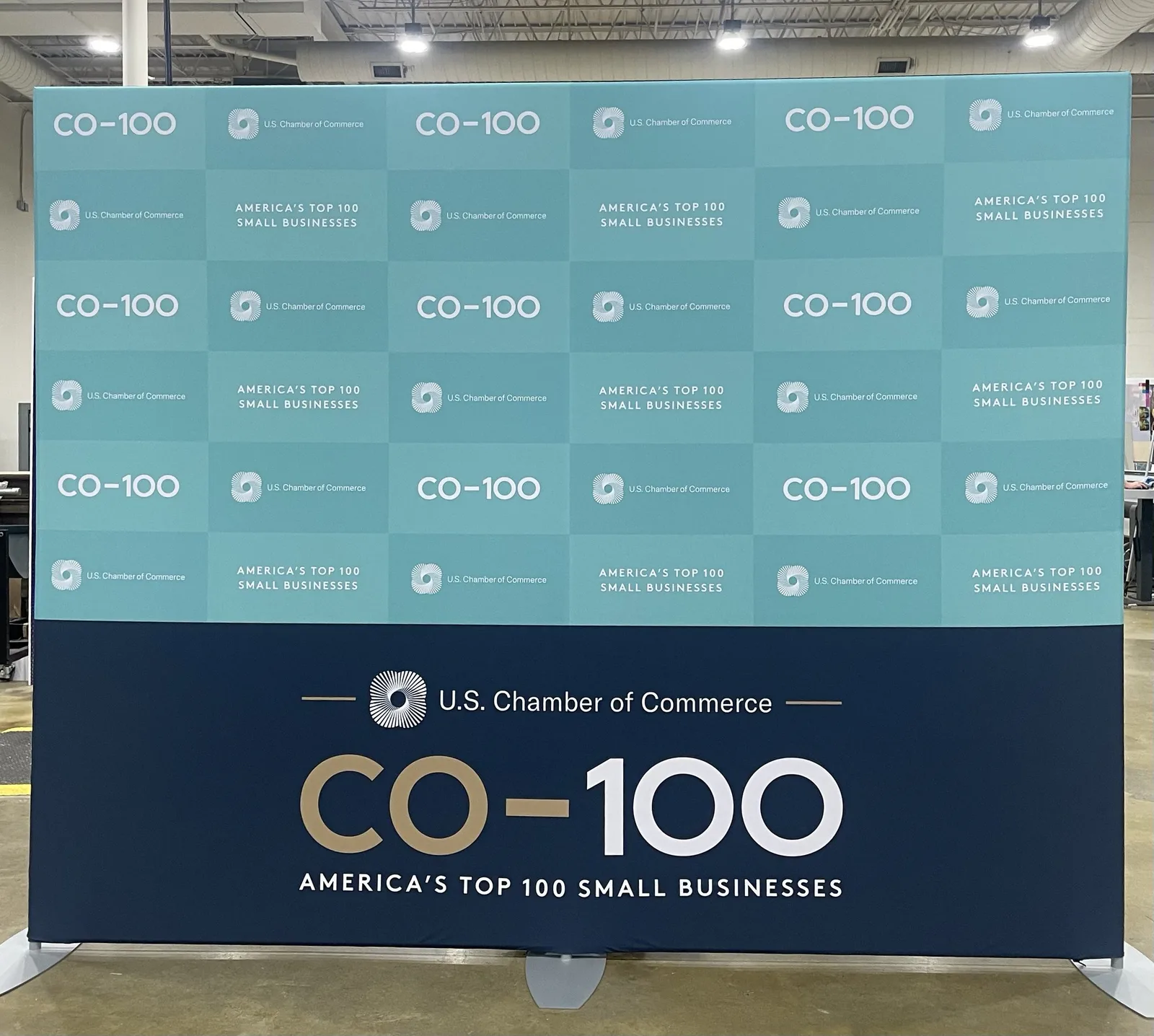
    That is where fabric shines. Step-and-repeat backdrops photograph cleanly for press conferences and media walls, and dye-sublimated fabric banners are lightweight, packable, and reusable across a full season of shows. Because the color is infused into the fibers rather than sitting on top, fabric holds its saturation booth after booth. Our dye-sublimated fabric displays cover backdrops, hanging banners, and soft signage built for repeat travel.

    How to prepare banner artwork so it prints sharp

    A clean file is what separates a crisp banner from a fuzzy one. Every CSI banner is finished for how it will hang, but the print quality starts with the artwork you send. A few rules keep large-format output sharp:

    • Design at scale. Build the file at the final size, or at a clean fraction of it, so the software is not guessing when it enlarges your art.
    • Use vector logos and type. Vector art stays razor sharp at any size, while low-resolution photos pulled from a website will look soft when blown up to banner scale.
    • Respect viewing distance. A banner read from across a parking lot needs bigger type and higher contrast than one read from a few feet away at a trade show booth.
    • Leave quiet margins. Keep critical text away from grommets, pole pockets, and hems so nothing important gets punched or folded.

    If you are not sure your file is print-ready, send it over and the team will check resolution, bleed, and color before anything goes to press. You can get in touch to start a quote or a file review.

    The team behind the banner

    CSI has printed large format graphics in the DC metro since 1995, and the company traces back to 1976, when Composition Systems Incorporated started as a small Alexandria typesetting shop before growing into one of the largest graphics producers in the DC, Maryland, and Virginia area. In 2026, CSI joined forces with Duggal Visual Solutions, which added capacity while the Alexandria team continues to run independently across the DMV. That mix of decades of local experience and expanded resources is what lets the shop turn a rush building banner and a delicate museum-quality fabric print on the same week.

    Frequently Asked Questions

    What is the best banner material for outdoor use in Washington, DC? For most outdoor installs, heavyweight vinyl is the durable, waterproof default. If the site is windy or the banner is elevated, mesh is the safer choice because it lets air pass through the weave instead of catching it, which reduces strain and tearing.

    Do I need a permit to hang a banner in Washington, DC? In most cases, yes. The District requires a permit to erect or replace an exterior sign, and a separate public space permit if the banner will hang over a sidewalk, street, or other public property. Requirements differ in the Virginia and Maryland suburbs, so confirm locally before printing.

    How large can a banner be printed? Grand-format presses print banners up to 196 inches wide, and multiple panels can be seamed for building banners and other oversized graphics. Size is rarely the limiting factor for a Washington, DC project.

    How fast can a banner be produced? Turnaround depends on size, material, and finishing, but grand-format output measured in thousands of square feet per hour means large banners and rush event work can move quickly. Send your file early and confirm the deadline up front.

    What file should I send for a banner? Send high-resolution or vector artwork built at the final size when possible, with logos and type in vector format. The team will review resolution, bleed, and color before printing to make sure the banner prints sharp.

    Ready to price a project? Reach out through our get in touch page with your size, material, and deadline, and CSI will handle the rest from file check to install.

    Previous
    Previous

    Brochure Printing in Washington, DC: A Buyer's Guide

    Next
    Next

    Sign Installation in Washington DC: The Complete Guide

  • Sign Installation in Washington DC: The Complete Guide

    Sign Installation in Washington DC: The Complete Guide

    Sign Installation in Washington DC: The Complete Guide

    Sign Installation in Washington DC: The Complete Guide

    Sign installation in Washington DC is the process of surveying a location, securing the required permits, fabricating a sign to code, and mounting it safely so it stays put and stays compliant. In a dense, heavily regulated market like the District and its Virginia and Maryland suburbs, the install is where a graphic becomes a working piece of your storefront, lobby, or event. Get the permitting, placement, and mounting right and the sign earns its keep for years. Get them wrong and you are looking at fines, rework, or a safety hazard.

    This guide walks through what the job actually involves, the rules that apply in the DC metro, the kinds of signs a professional crew handles, and how to choose an installer you can trust with a building exterior or a trade-show floor.

    Key Takeaways

    • A new sign can add real revenue. Signage Foundation research found a new building, pole, or multi-tenant sign lifted a location's sales returns by 5 percent to 15 percent.
    • In Washington DC, a permit is required to erect or replace an exterior sign, and the application must include architectural plans showing sign dimensions and elevations.
    • Interior tactile signs must follow ADA mounting rules: 48 inches minimum and 60 inches maximum above the finish floor, placed on the latch side of the door.
    • Exterior and elevated installs are fall-hazard work. OSHA requires fall protection at four feet in general industry and six feet on construction sites.
    • Choose an installer with local permit knowledge, in-house fabrication, proper insurance, and a track record on projects like yours across the DC, Virginia, and Maryland region.

    How much does a sign really affect your business?

    A well-placed sign is one of the highest-return marketing assets a business owns. According to research from the Signage Foundation reported by Sign Media Canada, adding a new building sign, pole sign, or free-standing multi-tenant sign lifted a location's sales returns by 5 percent to 15 percent. In the same body of research, nearly a quarter of surveyed businesses said they hired additional staff because of the sales boost that new signage produced.

    That return only shows up when the sign is installed correctly. A banner that sags, a channel letter set that drifts out of alignment, or a lobby sign mounted at the wrong height undercuts the very impression it was meant to create. Installation is not the afterthought at the end of a print job. It is the step that determines whether the finished graphic reads as sharp and permanent or cheap and temporary. For large-format work especially, where a single wall wrap or building banner can span an entire facade, the mounting method and surface prep decide how long the piece survives DC weather.

    Do you need a permit to install a sign in Washington DC?

    Yes. In most cases you need a permit before you install. The DC Department of Buildings states that a permit is required to erect and replace an exterior sign, including signs that advertise a business. The application is not a rubber stamp either. It must include architectural plans detailing the sign's dimensions and elevations, a Certificate of Occupancy confirming the use of the space, and, for ground signs, a surveyor's plat showing the location.

    Signs that project over public space add another layer, because the District reviews what hangs above its sidewalks and streets. Historic districts, which cover large parts of DC and nearby Alexandria, can impose further design review. This is exactly where local experience pays for itself. An installer who works the DC metro every week knows which drawings the reviewers expect, how long approvals typically take, and how to size and place a sign so it clears the code the first time. Skipping the permit is a false economy. Unpermitted signs can be ordered down, and the cost of removal plus reinstallation almost always dwarfs the price of doing it right at the start. If you are weighing a storefront or building sign, our DC-metro signage installation team can scope the permitting alongside the fabrication.

    What safety and code rules govern the install itself?

    Sign installation is regulated construction work, not decoration. Two rule sets carry most of the weight: fall protection for the crew and accessibility for the public.

    On the safety side, exterior and elevated installs are fall-hazard jobs. OSHA requires fall protection at elevations of four feet in general industry workplaces and six feet on construction sites, and it notes that falls are among the most common causes of serious work-related injuries and deaths. A building banner three stories up, a monument sign on a busy corridor, or a lift-mounted channel letter set all demand trained crews, rated equipment, and the right anchoring. This is a core reason to hire insured professionals rather than treat a large sign as a handyman task.

    On the accessibility side, interior signs that identify permanent rooms and spaces must meet the ADA. The U.S. Access Board specifies that raised characters and braille be located 48 inches minimum above the finish floor, measured from the baseline of the lowest tactile character, and 60 inches maximum, measured from the baseline of the highest tactile character. Those signs also belong on the latch side of the door, not on the door itself. Wayfinding and room-ID programs live or die on these details, and an installer who builds them into the plan saves you a failed inspection later. You can see how this plays out in real projects on our guide to wayfinding and monument signs in the DC area.

    What types of signs does a DC-metro installer handle?

    A full-service installer covers everything from a lobby nameplate to a wrapped building. CSI Printing & Graphics has spent more than 30 years on this work, and our vendor approvals from Outfront Media, Clear Channel, and JCDecaux reflect the standard required for outdoor and transit sign installation. Our installation crews handle six broad categories:

    • Wall and window graphics, including professionally applied vinyl decals, murals, and privacy films
    • Event and trade-show signage and displays for convention centers, hotels, and corporate venues
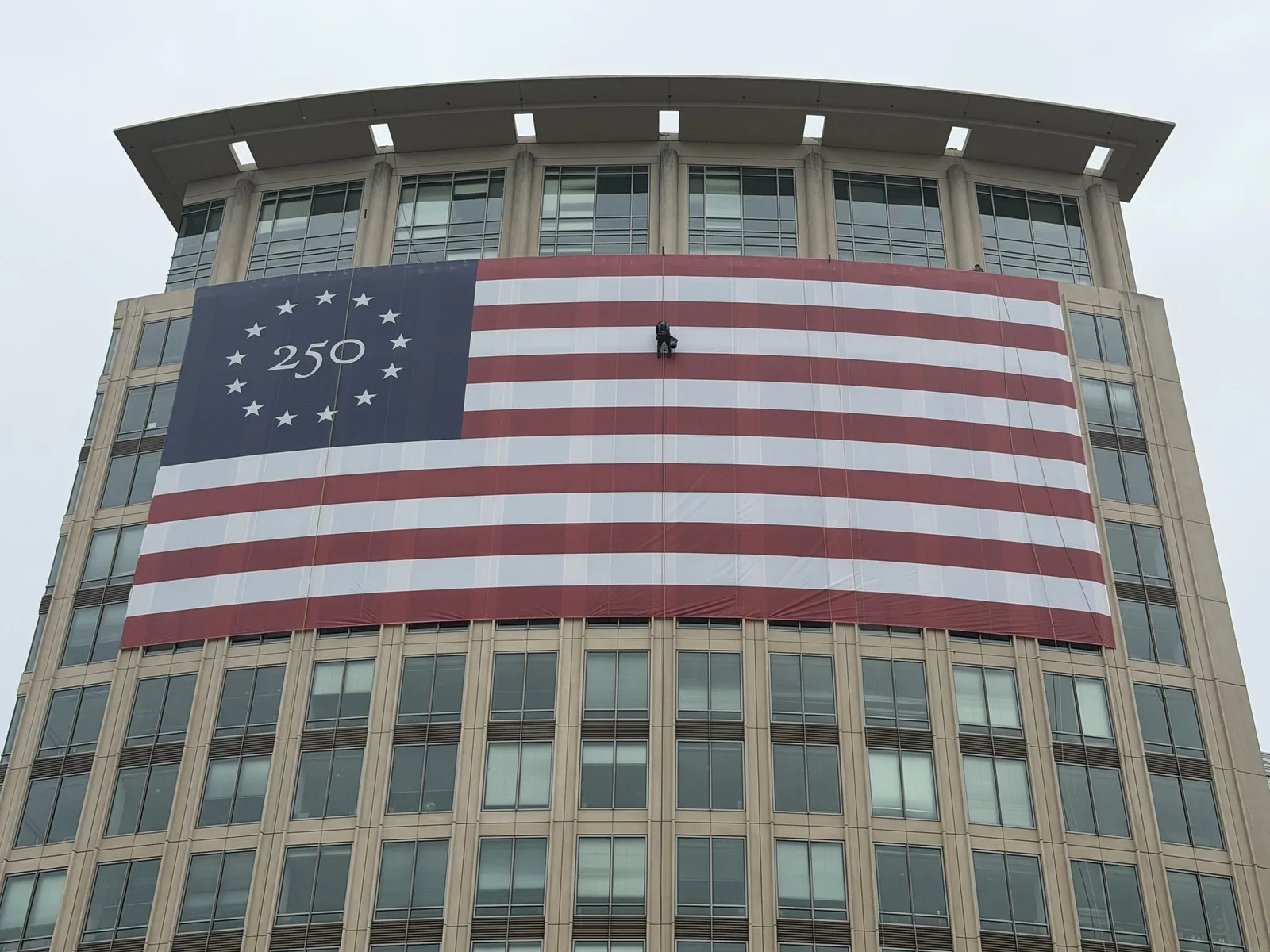
    • Exterior and building signage, from storefront signs to large facade graphics
    • Vehicle wraps and fleet graphics for company cars, vans, and transit
    • Floor graphics and wayfinding signage for offices, retail, and public buildings
    • Large-scale banners and billboards for high-visibility outdoor advertising

    The scope is not theoretical. Real DC-area installs include pole banners for the Washington Nationals and the NHL Winter Classic, mall graphics for Macerich at Tysons Corner Center, bus wraps for the Fairfax Connector, and mesh building banners across the District. Behind those installs sits an in-house production floor. Because we print, cut, finish, and install under one roof, the crew that hangs the sign knows exactly how it was built and on what material. You can review the presses and substrates on our capabilities page, which lists flatbed and dye-sublimation equipment along with the rigid boards, vinyls, and fabrics we mount every week.

    How do you choose a sign installation company in Washington DC?

    Start with proof that the crew can do the work safely and legally. Because installs are fall-hazard construction, and OSHA counts falls among the leading causes of serious workplace injuries, a legitimate installer carries liability insurance and workers' compensation and can produce certificates on request. Ask for both before anyone gets on a lift near your building.

    From there, weigh five practical factors:

    1. Local permit fluency. Does the company pull DC, Alexandria, and Fairfax permits regularly and know the public-space and historic-district reviews?
    2. In-house fabrication. An installer that also prints and finishes controls quality end to end and can fix a problem on the spot instead of pointing at a third-party vendor.
    3. Relevant track record. Ask to see installs like yours, whether that is a retail storefront, a trade-show booth, a fleet, or a full building wrap.
    4. Material and surface expertise. DC brick, glass curtain walls, and drywall each demand a different adhesive, substrate, and mounting method.
    5. Full-service coverage. A single accountable partner for design, print, permitting, and installation removes the finger-pointing that stalls multi-vendor jobs.

    CSI Printing & Graphics checks each of these for clients across Washington DC, Northern Virginia, and Maryland, and we handle nationwide installs for accounts with locations in multiple markets. For a closer look at how we pair fabrication with on-site work, see our overview of professional signage installation and event graphics in the DC metro area. When you are ready to scope a project, you can get in touch with our Alexandria team.

    Frequently Asked Questions

    Do I always need a permit to install a sign in Washington DC? For exterior signs, almost always. The DC Department of Buildings requires a permit to erect or replace an exterior sign, and the application must include plans showing the sign's dimensions and elevations. Interior signs generally do not require the same permit, but they still must meet ADA and building-code requirements. A local installer will confirm what your specific sign needs before fabrication begins.

    How high should an ADA room sign be mounted? The 2010 ADA Standards require raised characters and braille to sit 48 inches minimum above the finish floor, measured from the baseline of the lowest tactile character, and 60 inches maximum, measured from the baseline of the highest tactile character. The sign belongs on the latch side of the door, with clear floor space in front of it.

    Can one company handle design, printing, and installation? Yes, and it is usually the better path. A full-service shop like CSI Printing & Graphics prints, finishes, and installs in-house, so the same team that produces the sign also mounts it. That keeps color, material, and mounting decisions consistent and removes the coordination gaps that appear when separate vendors split the job.

    How long does sign installation take in the DC metro? Timelines depend on permitting and complexity more than on the mounting itself. A simple interior sign can go up in a day once it is fabricated, while a permitted exterior or building sign may take several weeks because of the plan review and approval process. Building the permit timeline into the schedule early is the single biggest factor in hitting an install date.

    What areas does CSI Printing & Graphics serve? CSI is based at 840 South Pickett Street in Alexandria, Virginia, and serves Washington DC, Northern Virginia, and Maryland, with nationwide installation for accounts that operate in multiple locations. You can reach the team at 703.205.0000 or CSI@CSI2.COM.

    Previous
    Previous

    Banners in Washington, DC: Materials, Sizes, and Permits

    Next
    Next

    Trade Show Displays in Washington DC: A Practical Guide for Exhibitors

  • Trade Show Displays in Washington DC: A Practical Guide for Exhibitors

    Trade Show Displays in Washington DC: A Practical Guide for Exhibitors

    Trade Show Displays in Washington DC: A Practical Guide for Exhibitors

    Trade Show Displays in Washington DC: A Practical Guide for Exhibitors

    Trade show displays are the printed and structural graphics that define an exhibitor's booth: banner stands, step-and-repeat backdrops, fabric graphics, rigid panels, hanging booth signage, and floor graphics. In Washington, DC, where the convention calendar runs all year, a display has to travel well, set up fast, and read clearly across a crowded hall. This guide walks through the display types that work, the materials behind them, how to plan a booth, and why producing and installing your graphics with a local Washington, DC metro partner lowers the risk on show day.

    Key Takeaways

    • Trade show displays span banner stands, step-and-repeat backdrops, fabric graphics, rigid panels, and floor graphics, and the right mix depends on your booth size and how often you exhibit.
    • Face-to-face exhibitions are the single largest line in exhibitors' marketing budgets, at 41 percent, according to CEIR data reported by PCMA.
    • Washington, DC anchors a major convention market. The Walter E. Washington Convention Center offers more than 700,000 square feet of exhibit space, per Events DC.
    • Material choice (rigid, roll, or fabric) drives weight, durability, and how many shows a display can survive.
    • A local Alexandria, VA producer can print, reprint, and install your booth graphics on-site across the DC metro.

    What are trade show displays, and what does a DC exhibitor need?

    Attendance at U.S. business-to-business exhibitions has nearly returned to pre-pandemic levels, sitting only 3.7 percent below 2019 in the second quarter of 2025, according to the CEIR Q2 2025 Index reported by IAEE. That means the floors are full again, and a booth needs graphics that compete for attention.

    At the simplest level, a trade show display is any printed graphic or structure that carries your brand in the booth. The common categories are:

    • Retractable and vinyl banner stands: the workhorse of most booths, easy to ship and set up.
    • Step-and-repeat backdrops: the logo-tiled wall used for photos, press moments, and media events.
    • Fabric displays: lightweight, wrinkle-resistant graphics printed by dye sublimation for a premium, wall-sized look.
    • Rigid panels and signage: printed on stiff substrates for counters, kiosks, and freestanding signs.
    • Floor and hanging graphics: directional and overhead branding that pulls foot traffic toward your space.

    CSI produces these formats in-house. The large format printing line covers banners, fabric prints, and rigid work on substrates including Gatorboard, foam core, coroplast, acrylic, PVC, and aluminum, plus roll materials such as vinyl, mesh, and canvas. The dedicated banners and fabric pages show the step-and-repeat backdrops and dye-sublimation fabric graphics that events rely on.

    Why trade show displays still earn their place in a DC marketing budget

    Face-to-face exhibitions account for the largest share, 41 percent, of exhibitors' marketing budgets across all budget sizes, according to CEIR research reported by PCMA. That same reporting notes that 362 B2B exhibitors ranked events as their number one marketing investment. When a channel commands that much spend, the physical presentation of your booth is not a detail. It is the return on the whole line item.

    A trade show is one of the few moments a buyer will stand in front of your brand, in person, ready to talk. The display sets the first impression before anyone reaches the booth. Faded graphics, crooked banners, or a backdrop that arrives creased can undercut a five-figure exhibition spend in the first three seconds. Print quality and clean installation are what protect that investment.

    Washington, DC is a top-tier convention market, and that shapes your display

    The Walter E. Washington Convention Center offers more than 700,000 square feet of exhibit space and 77 meeting rooms, according to Events DC. Add the trade associations, policy conferences, and industry expos that fill hotel ballrooms across the region, and the DC metro becomes one of the busiest exhibition markets in the country.

    That geography matters for a practical reason. The DC metro is really one connected market that spans the District, Alexandria and Northern Virginia, and Bethesda in Maryland. A producer based in Alexandria can reach any of those show floors in a short drive, which turns last-minute reprints and on-site fixes into a same-day errand rather than an overnight freight gamble. CSI has served this market for more than 30 years, and its team works with corporate, retail, education, real estate, and events and trade show clients across the region.

    The core display types for a DC booth, and the materials behind them

    Most exhibitors keep their booth footprint stable from show to show. A CEIR survey found that 83 percent of exhibitor respondents planned to keep their booth size the same, per the PCMA reporting above. Consistency like that is an argument for building durable, reusable displays rather than reprinting a full booth every season. The table below maps common display types to the materials that suit them.

    Display type Typical material Best for
    Retractable banner stand Roll vinyl or fabric Portable messaging, quick setup, aisle sightlines
    Step-and-repeat backdrop Dye-sublimation fabric or vinyl Photos, press conferences, and media moments
    Wall-sized fabric graphic Dye-sublimation fabric A smooth, one-piece booth back wall that packs light
    Counter and kiosk panels Gatorboard, foam core, PVC, or acrylic Rigid, freestanding brand surfaces and product signage
    Floor graphics Adhesive-backed vinyl Directional branding that pulls traffic into the booth

    Fabric graphics deserve a note of their own. CSI prints them by dye sublimation, a process that pushes ink into the fibers so color stays rich and the panel folds down small for travel. Rigid substrates go the other way, trading portability for a hard, structural surface that stands on its own. Choosing between them is really a choice about how your booth ships, sets up, and gets stored between shows.

    How to choose the right trade show display: a buyer's checklist

    Exhibitors are holding steady on their calendars, with 47 percent planning to exhibit at the same number of events as the prior year and 28 percent planning to add shows, according to the CEIR data in the PCMA report. If exhibiting is a recurring commitment, the display you buy should be built to repeat. Work through this checklist before you order:

    • Booth size and space: match graphic dimensions to your reserved footprint, whether that is a tabletop, a 10 by 10, or an island.
    • Indoor or outdoor: outdoor and high-traffic entrances call for weather and tear-resistant materials such as mesh or reinforced vinyl.
    • Reuse frequency: if the display travels to several shows a year, favor durable, replaceable panels over one-time prints.
    • Shipping and weight: fabric and roll materials pack small and light, while rigid substrates need cases and add freight cost.
    • Setup and installation: decide what your team can raise alone and what needs a professional install crew.
    • Brand consistency: keep colors, logos, and type matched to your printed collateral so the booth and the brochures look like one brand.

    Why local production and installation matter for Washington DC exhibitors

    With 41 percent of exhibitor budgets riding on face-to-face events, a graphic that arrives damaged or a backdrop that will not hang straight is an expensive problem to discover an hour before doors open. Proximity is the cheapest insurance against that. A local producer can rerun a panel the same day, meet you at the venue, and hang the booth so the print actually looks like the proof.

    CSI treats setup as part of the print job, not an afterthought. Its installation service lists event and trade show signage and displays directly, setting up backdrops, wayfinding signage, banners, and booths, and the company frames it plainly: a great print is only as good as its execution. For an exhibitor traveling into DC from out of town, a partner already inside the market removes the freight risk and the scramble for a local crew you have never met.

    If you are planning a booth for a show at the convention center or a DC-area hotel, it helps to start the conversation early, while the booth design is still flexible. You can reach the CSI team through the contact page to talk through display types, materials, and installation for your specific show.

    Frequently asked questions

    Where can I get trade show displays in Washington, DC?

    CSI Printing & Graphics produces trade show displays for the Washington, DC metro from its Alexandria, VA facility at 840 South Pickett Street. The company prints banners, step-and-repeat backdrops, fabric graphics, and rigid signage in-house and installs booths on-site across the District, Northern Virginia, and suburban Maryland.

    What is the most portable trade show display?

    Fabric graphics and retractable banner stands are the most portable options. Dye-sublimation fabric folds down small and resists wrinkling, and retractable stands roll into their own base, so both travel light compared with rigid panels that need protective cases.

    Can one display be reused across multiple shows?

    Yes. Durable materials such as dye-sublimation fabric and quality banner hardware are built to be packed, shipped, and re-hung many times. Because most exhibitors keep the same booth size year to year, a well-built reusable display often costs less over a season than reprinting a booth for every event.

    Should trade show graphics match my other printed materials?

    They should. Keeping your booth graphics, brochures, and business cards on the same colors, logos, and type makes the brand read as one voice on the floor. Producing your large format displays and your small format collateral through the same printer is the easiest way to keep those elements consistent.

    Do you install booths on-site in the DC area?

    CSI offers installation as a service and lists event and trade show signage and displays among the work it sets up, including backdrops, wayfinding, banners, and booths. Being based in Alexandria means the crew can reach DC metro venues without long-distance freight or an unfamiliar local contractor.

    About CSI Printing & Graphics: Composition Systems Incorporated, doing business as CSI Printing & Graphics, is a commercial and large-format print, signage, and experiential-graphics company based at 840 South Pickett Street, Alexandria, VA 22304, serving the Washington, DC metro for more than 30 years. Reach the team at 703.205.0000 or CSI@CSI2.COM.

    Previous
    Previous

    Sign Installation in Washington DC: The Complete Guide

    Next
    Next

    Vehicle Wraps in Northern Virginia: A Business Guide

  • Vehicle Wraps in Northern Virginia: A Business Guide

    Vehicle Wraps in Northern Virginia: A Business Guide

    Vehicle Wraps in Northern Virginia: A Business Guide

    Vehicle Wraps in Northern Virginia: A Business Guide

    A vehicle wrap turns a company car, van, or full fleet into a moving advertisement that works every mile it drives. For businesses across Northern Virginia and the wider Washington DC metro, that is a rare kind of marketing: you pay once, and the message keeps working through every commute, job site, and delivery run. At CSI Printing & Graphics in Alexandria, the pitch is direct. Turn your company vehicles into mobile billboards with custom vehicle wraps and fleet graphics, using high-resolution vinyl that is durable, fade-resistant, and easily removable.

    This guide explains how vehicle wraps in Northern Virginia actually work: why they earn their place in a marketing budget, how long the material lasts, the difference between full wraps, partial wraps, and fleet graphics, and why the installation matters as much as the print. Every claim below is grounded in either first-party facts from CSI or a cited industry authority.

    Key Takeaways

    • Out-of-home advertising, the category that includes vehicle wraps, reached a record $9.46 billion in 2025 and has now grown for 19 straight quarters, according to the Outdoor Advertising Association of America.
    • Premium cast wrap films are engineered to last. Avery Dennison rates its MPI 1105 SuperCast vehicle-wrap film for up to seven years of durability, per its product data sheet.
    • The average U.S. driver logs 13,476 miles a year, the Federal Highway Administration reports, so a wrapped work vehicle is a paid ad on the road every one of those miles.
    • CSI offers single-vehicle wraps, full-fleet branding, partial wraps, and precision-cut graphics, and installs them with a team it describes as backed by decades of hands-on expertise.
    • The wrap film is only half the job. Surface prep, application temperature, and skilled installation decide whether graphics look sharp for years or peel within months.

    Why vehicle wraps work for Northern Virginia businesses

    Out-of-home advertising keeps growing because it keeps delivering, and vehicle wraps sit squarely inside that trend. The Outdoor Advertising Association of America reports that out-of-home revenue hit a record $9.46 billion in 2025, up 3.6 percent year over year and marking 19 consecutive quarters of growth. Digital out-of-home now makes up 36.3 percent of that total. The category is not a relic; it is expanding while budgets shift toward it.

    A vehicle wrap converts that broad trend into local reach you control. The Federal Highway Administration reports the average American driver covers 13,476 miles a year. A wrapped van running the Capital Beltway, I-395, or Route 1 through Alexandria and Arlington is not sitting in a driveway. It is passing thousands of commuters, pedestrians, and other drivers on roads that are busy for most of the day. Unlike a billboard tied to one intersection, your ad travels to Fairfax in the morning and Tysons in the afternoon.

    For a service business, the math is simple. You already own the vehicles. You already pay for fuel and drivers. Wrapping those vehicles adds a marketing channel on top of miles you were going to drive anyway. That is why CSI frames its vehicle wraps and fleet graphics as turning company vehicles into mobile billboards, whether you need to brand a single company car or an entire fleet.

    How long do vehicle wraps last?

    A quality vehicle wrap should last for years, not months, when it uses the right film and is installed correctly. Avery Dennison, a leading wrap-film manufacturer, rates its MPI 1105 SuperCast cast vinyl for durability of up to seven years, according to the product data sheet. That film is a 2.0 mil high-gloss cast vinyl built for compound curves and corrugations, the irregular shapes real vehicles are made of, with a long-term removable adhesive that comes off cleanly at the end of its life.

    Cast films earn that longevity because they are dimensionally stable and made to conform without shrinking back. That is the difference between graphics that stay tight around a bumper or door handle and graphics that lift at the edges. CSI describes its own wraps as high-resolution vinyl that is durable, fade-resistant, and easily removable, and the company has specialized in large format output of all types for nearly 30 years.

    Durability also protects your investment when priorities change. Because premium wrap films are designed to be removable, you can rebrand a vehicle, retire it from the fleet, or sell it later without the adhesive damage that cheaper materials leave behind. If your project pairs a wrap with printed panels or building graphics, CSI handles those through the same large format printing operation, so color and finish stay consistent across the whole rollout.

    Full wraps, partial wraps, and fleet graphics

    The right format depends on your budget, your vehicles, and how bold you want to be. CSI offers the full range: single company-car wraps, entire fleet wraps, specialty promotional vehicles, partial wraps, and full vehicle branding, all built from full-color vinyl printing and precision-cut graphics.

    A full wrap covers the entire body of the vehicle and gives you the most surface to work with, including the chance to change the base color of the vehicle entirely. A partial wrap covers select panels, doors, the rear, or a lower section, and delivers strong visibility at a lower material cost. Precision-cut graphics and lettering are the most economical option and work well when you mainly need your logo, phone number, and web address clearly visible.

    Fleet consistency is its own advantage. When every van, truck, and car carries the same colors and layout, the vehicles start to reinforce each other across the DC metro. A resident who sees your wrapped truck in Alexandria on Monday and again in Arlington on Thursday remembers the brand. If you are weighing how far to take a fleet program, CSI's guide to fleet branding strategies for DC businesses walks through the tradeoffs in more detail.

    Why professional installation matters

    The film is only half the job, and the install is where wraps succeed or fail. Manufacturer specifications make the point plainly: Avery Dennison sets a minimum application temperature of 45 degrees Fahrenheit for flat surfaces and 60 degrees for complex curves, and it requires substrates to be cleaned to a specific standard before any film touches the vehicle. Skip the prep or wrap a cold vehicle, and even a seven-year film can fail early.

    This is where an experienced local partner pays off. CSI describes its install team as backed by decades of hands-on expertise, with the staff, equipment, and experience to handle everything from a simple cut-vinyl application to a large-scale outdoor project. The company positions installation as a differentiator on purpose, noting that a great print is only as good as its execution.

    Professional installation also covers the details that make a wrap look finished: aligning graphics across panel gaps, wrapping edges and recesses, and working around handles, mirrors, and trim so seams disappear. CSI offers installation for vehicle wraps and fleet graphics alongside wall and window graphics, exterior and building signage, and floor graphics, and it provides coordinated installs across multiple locations when a fleet is spread out. That matters for a Northern Virginia business whose vehicles rarely sit still in one garage.

    What a vehicle wrap project looks like

    A vehicle wrap project moves through a few clear stages, and knowing them helps you plan. It starts with a consultation, and CSI offers a free wrap consultation to scope the vehicles, the goals, and the look. Design comes next, translating your brand into a layout that reads clearly at a distance and at speed, because a wrap that is too busy to absorb from a passing car is a wrap that underperforms.

    Design is worth real attention. Contrast, legibility, and a short, memorable message do more work than crowded detail. If you want to get the creative right before you commit, CSI's rundown of key considerations for effective vehicle wrap design covers what separates a wrap that sells from one that just decorates.

    After design approval, the graphics are printed on wrap-grade vinyl, laminated for protection, and installed by the team. Because CSI runs printing and installation under one roof in Alexandria, the same shop that produces the film also applies it, which keeps accountability in one place from proof to finished vehicle. To start a project or get a quote for your fleet, reach the team through the contact page or call the Alexandria shop directly.

    Frequently Asked Questions

    How much does a vehicle wrap cost in Northern Virginia?

    Cost depends on the vehicle size, whether you choose a full or partial wrap, and the complexity of the design and installation. Because those variables differ for every vehicle and fleet, the accurate way to price a project is a consultation. CSI offers a free wrap consultation so you get a figure based on your actual vehicles rather than a generic estimate.

    How long do vehicle wraps last?

    Premium cast wrap films are engineered for multi-year service. Avery Dennison rates its MPI 1105 SuperCast vehicle-wrap film for up to seven years of durability. Real-world lifespan depends on the film chosen, sun and weather exposure, and how well the vehicle is cleaned and cared for, but a professionally installed wrap using quality material is built to last for years.

    Will a wrap damage my vehicle's paint?

    Quality wrap films use removable adhesives designed to come off cleanly. Avery Dennison's MPI 1105 data sheet describes a long-term removable adhesive, and CSI describes its wraps as easily removable. Proper removal by an experienced installer, on factory paint in good condition, is what protects the finish underneath.

    Can you wrap an entire fleet, not just one vehicle?

    Yes. CSI wraps single company cars, specialty promotional vehicles, and entire fleets, and it can coordinate installs across multiple locations. Fleet-wide consistency is one of the strongest reasons to wrap, because matching vehicles reinforce your brand every time they appear around the DC metro.

    Do you serve businesses across the DC metro, not just Alexandria?

    CSI is based at 840 South Pickett Street in Alexandria, Virginia, and serves the Washington DC metro, including Northern Virginia communities such as Arlington and Fairfax. The company also provides coordinated installation wherever a fleet needs it.


    Published by the CSI Printing & Graphics team. CSI Printing & Graphics (Composition Systems Inc.), 840 South Pickett Street, Alexandria, VA 22304. Phone 703.205.0000. Email CSI@CSI2.COM.

    Previous
    Previous

    Trade Show Displays in Washington DC: A Practical Guide for Exhibitors

    Next
    Next

    Choosing a Sign Company in Washington DC: A 2026 Guide

  • Choosing a Sign Company in Washington DC: A 2026 Guide

    Choosing a Sign Company in Washington DC: A 2026 Guide

    Choosing a Sign Company in Washington DC: A 2026 Guide

    Choosing a Sign Company in Washington DC: A 2026 Guide

    Your sign is often the first thing a customer meets, and in a market as busy and as regulated as Washington DC, the vendor you pick decides whether that first impression lands. Choose the wrong partner and you inherit permit surprises, colors that do not match your brand, and an install that gets subcontracted to a crew that has never seen your artwork. Choose the right one and the whole project, from proof to mounted panel, runs through a single accountable team.

    A sign company in Washington DC designs, produces, and installs the signage a business uses to get noticed, from a storefront and lobby to a vehicle fleet and a trade-show booth. For a DC-area business, the safest choice is a local partner that prints signage in-house, understands District permitting, and installs its own work, so one team owns quality from the first proof to the final mounted sign. CSI Printing & Graphics has produced large-format graphics and signage from its Alexandria, Virginia shop for more than 30 years, serving the Washington DC metro along with national accounts.

    Key Takeaways

    • A sign company handles design, printing, fabrication, and installation. The strongest DC partners do all four under one roof.
    • In Washington DC, a permit is generally required to erect or replace an exterior business sign, so hire a company that knows District requirements.
    • Signage is a visible quality signal: most consumers judge a business by its signs, and poorly made signs actively cost you walk-ins.
    • Favor in-house production and an in-house install crew over a broker, so one team is accountable for color, materials, and the finished result.
    • Ask for a written quote tied to a specific spec, and a schedule that accounts for permits and site work. Be wary of prices quoted sight unseen.

    What does a sign company in Washington DC actually do?

    Signs still get noticed, and that is the whole point of hiring a good one. In a 2023 national study conducted for the Out of Home Advertising Association of America, 63 percent of adults said they had noticed a printed sign in the previous 30 days, and 88 percent had seen some form of out-of-home advertising in that same window. A sign company exists to make sure your business is one of the ones people notice.

    The work breaks into four jobs. First, design and file preparation, getting artwork print-ready at the right scale and color. Second, printing, which for signage usually means large-format output on rigid substrates like Gatorboard, acrylic, PVC, and aluminum, or on roll materials like vinyl, mesh, canvas, and wallcovering. Third, fabrication and finishing: cutting, routing, laminating, welding, grommeting, and sewing a raw print into a durable sign. Fourth, installation, mounting the sign safely and squarely where it belongs. A full-service shop also runs small-format digital printing for the brochures, badges, and event collateral that ride alongside a signage program. When one company owns every step, you avoid the finger-pointing that happens when a design house, a printer, and an install crew are three different vendors.

    Why does the quality of your signage matter?

    Your sign is a quality signal before a customer reads a single word. In a widely referenced FedEx Office survey, 68 percent of consumers said a store's signage is reflective of the quality of its products or services, and more than half, 52 percent, said they are less willing to enter a store with misspelled or poorly made signs. Cheap signage does not just look cheap. It talks people out of walking in.

    That cuts both ways, and the upside is real. A University of Cincinnati Economics Center study for the Sign Research Foundation found that businesses which updated their signage reported increases of about 10 percent in sales, profits, and number of transactions. Signage is one of the few marketing assets a customer sees every single day, so the craftsmanship, the material choice, and the color accuracy are not cosmetic details. They are the return on the investment.

    Do you need a permit for a business sign in Washington DC?

    Usually, yes. The DC Department of Buildings states plainly that "a permit is needed to erect and replace an exterior sign," and that this includes signs that advertise a business. Skipping that step can mean fines, a forced takedown, and a delayed opening, which is exactly the outcome a new sign is supposed to prevent.

    The practical rules vary by sign type, size, location, illumination, and whether the sign touches public space, and they can differ again just across the river in Arlington, Alexandria, or the Maryland suburbs. That is why permitting knowledge is a real reason to hire local. A company that pulls signs up across DC, Northern Virginia, and Maryland every week can flag a likely permit requirement before you have committed to a design, rather than after fabrication. Always confirm the current requirements with the DC Department of Buildings, or the relevant local authority, before you build. A sign partner that has done the paperwork in your jurisdiction saves you the version of this lesson that costs money. For projects in the District and the surrounding metro, CSI works across the VA, DC, and MD region and can help you plan around it. If you are weighing a specific site, get in touch before the design is final.

    What should you look for when choosing a DC sign company?

    Start with production. The single biggest difference between sign companies is whether they actually make the signs or simply resell someone else's work. An in-house shop controls color, materials, quality, and schedule. A broker controls a phone. Use this checklist when you vet a candidate:

    • In-house production, not a broker. Ask what they print themselves versus what they outsource, and where.
    • A portfolio of comparable work. Look for real projects near your scale and type, whether that is museum and exhibit graphics, restaurant and retail signage, wall murals, or trade-show builds.
    • A genuine range of materials and formats. Rigid and roll, interior and exterior, small format and grand format.
    • Its own installation crew. One team through the mount is worth more than the lowest print price.
    • Honest turnaround and proofing. A real proof before production, and a schedule you can plan around.
    • Local references and a track record. Ask for DC-area clients you can actually check.

    CSI checks these boxes with in-house UV flatbed and dye-sublimation printing, complete finishing and fabrication including cutting, routing, laminating, welding, grommeting, and sewing, and professional installation, so the same partner is accountable from artwork to the wall. As the shop puts it, a great print is only as good as its execution.

    Which types of signs work best for DC-area businesses?

    Exterior signage does the heavy lifting. In the same OAAA study, about 69 percent of adults said they had noticed a billboard in the past 30 days, and the storefront, monument, and building signs a business owns work the same way, day after day, for free. The right mix depends on your space and your goals, but a DC-area business usually draws from a handful of proven formats:

    • Exterior and building signage: storefronts, monument signs, building wraps, and construction-site graphics that establish your presence on the street.
    • Wall murals and environmental graphics: interior branding and experiential graphics that turn a lobby, restaurant, or exhibit into part of the experience.
    • Vehicle wraps and fleet graphics: rolling advertising for teams across Alexandria, Northern Virginia, and the wider metro that earns impressions every mile.
    • Trade-show and event graphics: backdrops, banners, and displays built to travel, set up fast, and pack down clean.
    • Wayfinding and interior signage: the quiet system that helps visitors move through a building without asking.
    • Banners: short-run, high-impact pieces for a grand opening, a sale, or a civic event.

    If your project is specifically large-format, our large-format printing buyer's guide for Washington DC goes deeper on materials, durability, and the questions to ask a printer.

    Local partner or national vendor: which is right for your project?

    For permit-sensitive, install-heavy, deadline-driven work in the District, a local partner that prints and installs in-house is usually the better call. When a proof needs a same-week change or a mount has to be reworked, a nearby team closes the loop in days instead of shipping the problem across the country. Local also means the crew has seen your building type and your jurisdiction's rules before.

    National reach still matters for the right job. A multi-location rollout or a traveling exhibit benefits from a shop that can coordinate installs well beyond one market. The strongest position is a company that does both: rooted in the DC metro for the local work, and able to produce and ship for accounts across the country. CSI operates that way from Alexandria, handling regional signage and national accounts from a single production floor. That history, going back to the company's roots in 1976, is part of why so many of its prints are out in public without its name on them.

    Frequently Asked Questions

    How much does a business sign cost in Washington DC?

    There is no single price, because cost depends on the sign type, size, materials, quantity, permitting, and installation. A vinyl storefront graphic, an illuminated exterior sign, and a full vehicle wrap sit at very different price points. Ask for a written quote tied to a specific spec, and treat any number quoted before a shop has seen your site and your artwork with caution.

    Do I need a permit for a sign in Washington DC?

    In most cases, yes for exterior signs. The DC Department of Buildings states that a permit is needed to erect and replace an exterior sign, including business advertising. Requirements vary by sign type and location, and public-space signage can involve extra review, so confirm the current rules with the DC Department of Buildings, or your local jurisdiction, before you fabricate.

    How long does it take to produce and install a sign?

    It depends on the format, materials, permitting, and install complexity. Small-format digital work can move quickly, and CSI lists same-day or next-day turnaround for small-format jobs. Larger exterior and installed signage takes longer once permits and site surveys are factored in, so ask your sign company for a schedule built around your specific project rather than a generic quote.

    Can one company handle both printing and installation?

    Yes, and it is usually the better path. When the same team prints and installs, one partner owns color, materials, and the final mounted result, which removes the handoffs where quality slips. CSI produces signage in-house and installs its own work, treating installation as part of the job rather than a separate vendor's problem.

    What kinds of signage can a Washington DC sign company produce?

    A full-service shop can produce banners, building and storefront signs, wall murals and environmental graphics, vehicle wraps and fleet graphics, trade-show and event displays, wayfinding, and interior branding, plus small-format print such as brochures, badges, and event collateral to match.

    About CSI Printing & Graphics

    CSI Printing & Graphics (Composition Systems Inc.) is a commercial printing and large-format signage company at 840 South Pickett Street, Alexandria, VA 22304, serving the Washington DC metro and national accounts since 1976. The shop covers large format printing, small format digital printing, and professional signage installation from one production floor. To scope a project, call 703.205.0000, email CSI@CSI2.COM, or request a quote.

    Previous
    Previous

    Vehicle Wraps in Northern Virginia: A Business Guide

    Next
    Next

    Commercial Printing in Washington, DC: A Buyer's Guide

  • Commercial Printing in Washington, DC: A Buyer's Guide

    Commercial Printing in Washington, DC: A Buyer's Guide

    Commercial Printing in Washington, DC: A Buyer's Guide

    Commercial Printing in Washington, DC: A Buyer's Guide

    Commercial printing in Washington, DC means production-grade print for organizations, not the desktop and copy-shop work a consumer buys. In the DC metro it covers three connected disciplines. Large format graphics: signage, banners, wall murals, and exhibit work. Small format digital print: brochures, direct mail, and event collateral. And professional installation, which mounts the finished piece on a wall, a window, a booth, or a vehicle. The strongest partners run all three in-house. A museum exhibit, a storefront rebrand, or a trade show booth then ships as one coordinated job, not three vendors pointing at each other.

    We are CSI Printing and Graphics. We produce and install this work every day from our shop in Alexandria, VA, and this guide reflects how we scope it for clients across the DC metro.

    Key Takeaways

    • Commercial printing for a DC organization spans large format signage, small format collateral, and installation. The strongest partners handle all three in-house.
    • Signage drives demand. The International Sign Association reports that 33 percent of shoppers have entered an unfamiliar store because of the quality of its sign. Another 54 percent have driven past and missed a business because its signage was unclear or too small.
    • The DC metro is a physical-media market. Out-of-home advertising revenue hit a record 9.46 billion dollars in 2025, its 19th straight quarter of growth, per the Out of Home Advertising Association of America.
    • Trade show and exhibit graphics still pay off here. CEIR data shows in-person attendance has recovered to within 3.7 percent of pre-pandemic 2019 levels.
    • Vet capability before price. Ask any printer to show real equipment, approved substrates, and installation crews. Capability, not the lowest quote, protects a deadline.

    What does commercial printing include in Washington, DC?

    Commercial printing in Washington, DC serves one of the country's densest business markets. The Washington-Arlington-Alexandria metro is one of the nation's largest, home to more than 6 million residents according to U.S. Census Bureau estimates. That density pushes demand toward physical, place-based print, from storefront signage to convention graphics.

    The work splits into three service lines that feed each other. Large format printing makes oversized graphics on rigid and roll materials: banners, building wraps, wall murals, exhibit panels, and monument signs. Small format digital printing makes the paper a brand hands out or mails: brochures, business cards, programs, catalogs, and direct mail. Installation is the field work that mounts, wraps, and hangs the finished graphics on site.

    Large format printingSmall format digital printing
    Typical outputBanners, wall murals, exhibit panels, vehicle wrapsBrochures, business cards, programs, direct mail
    MaterialsRigid board, vinyl, mesh, fabric, adhesive filmCoated and uncoated paper and card stocks
    Where it livesWalls, windows, streets, booths, vehiclesHands, mailboxes, folders, events
    Common finishingLaminating, grommets, mounting, installationLaminating, binding, coating, folding

    Geography matters more here than in most markets. The District, Alexandria and Arlington, and the Maryland suburbs of Bethesda and Silver Spring pack agencies, museums, associations, restaurants, and retailers into a tight corridor. Permits, event calendars, and building access all move fast. We run large format, small format, and installation as three core lines from Alexandria, so a DC-metro project stays on one schedule and one point of contact.

    Large format printing is how DC brands claim physical space

    Thirty-three percent of shoppers have walked into a store they had never visited before because of the quality of its sign, according to research summarized by the International Sign Association. Another 54 percent have driven past and failed to find a business because its signage was unclear or too small. In a walk-up, drive-by market like DC, a weak sign costs revenue every day it stays up. That is why large format anchors most commercial print work here.

    Large format is a materials discipline as much as a printing one. Our capabilities page lists production presses including a swissQprint Nyala flatbed and several Durst systems. On the rigid side we print Gatorboard, DiBond, acrylic, PVC, and aluminum. On the roll side we run adhesive vinyl, mesh, canvas, and printable wallpaper.

    That range is the point. One shop can produce a museum exhibit wall, a restaurant's window graphics, and an office lobby mural without outsourcing any of it. Matching the substrate to the surface is what separates a mural that lasts years from one that peels in a season.

    Outdoor and grand format graphics for a high-traffic market

    Out-of-home advertising revenue reached a record 9.46 billion dollars in 2025, the Out of Home Advertising Association of America reported. That was up 3.6 percent year over year, a 19th straight quarter of growth. Physical placement keeps compounding while digital channels fragment. A metro full of commuters, tourists, and conventions rewards brands that show up on the street.

    Grand format print is defined by width and by where the finished piece may hang. Our capabilities include a Durst Rho 512r grand format press that runs material close to 16 feet wide. Our substrates are approved by major out-of-home operators including Outfront Media, Clear Channel, and JCDecaux.

    Those approvals are not a technicality. A billboard or transit wrap has to meet the media owner's specification before it can be posted. Buying from a printer whose stock is already approved removes a common cause of rejected, reprinted, and late campaigns.

    Trade show and event graphics in the DC metro

    In-person trade show attendance has recovered to within 3.7 percent of pre-pandemic 2019 levels, the strongest reading of any metric the Center for Exhibition Industry Research tracks, per the International Association of Exhibitions and Events. For an association, agency, or exhibitor working the DC and National Harbor convention circuit, booth graphics are still where a first impression is won or lost.

    Event work is deadline work, and it usually needs print and hands on site. We produce the full event kit, from fabric backdrops and hanging banners to badges, programs, and wayfinding. Our installation crews then set up backdrops, booth panels, and signage at the venue.

    Consolidating production and install matters most when a booth has to be built and struck inside a tight show window. One team owns both the file and the floor, so nothing gets lost in a handoff on show day.

    Small format digital printing: brochures, direct mail, and collateral

    Small format digital printing covers the paper a brand still puts in a hand. This is the brochure a real estate team leaves behind, the program handed out at a gala, the catalog mailed to a member list, and the branded binder used in a pitch. Short runs and variable data, where each printed piece can carry a different name or offer, make digital the right tool for targeted local campaigns.

    We run an HP Indigo digital press for small format work. We offer variable data printing, specialty coatings, and in-house finishing such as laminating and binding, with same-day or next-day turnaround on qualifying jobs. Keeping design, print, and finishing under one roof is what lets a rush program or a last-minute reprint actually make the deadline.

    Installation is what separates a printer from a partner

    Installation decides whether a printed graphic performs, and it is the line most buyers underestimate. A perfectly printed wall mural that bubbles on the wall fails in the exact moment it was made for. So does an exhibit panel that racks in transit. Our own framing is simple: printing is just the beginning.

    Field installation is its own craft. It takes surface prep, careful substrate handling, alignment on uneven walls, weather-rated exterior mounting, and safe removal without damage. Our installation team handles wall and window graphics, exterior and storefront signage, floor graphics, vehicle and fleet wraps, and event setups. We cover the DC metro locally and travel for multi-location rollouts. When a brand refreshes signage across several Northern Virginia or Maryland sites at once, one crew working from one set of files keeps every location consistent.

    How to choose a commercial printing partner in Washington, DC

    Choosing a commercial printing partner in Washington, DC comes down to one question: can a single company carry the project end to end? The lowest line-item quote often hides the cost of coordinating three vendors. It is usually the deadline, not the invoice, that hurts. Use this short checklist before you commit.

    1. In-house range. Confirm the shop runs large format, small format, and installation itself, so a mixed project stays on one schedule.
    2. Real equipment and substrates. Ask to see the press list and material options, as on our capabilities page, and confirm outdoor substrates are approved by the relevant media owners.
    3. Local plus reach. A DC-metro address means faster site surveys and installs, while national capability covers multi-location rollouts.
    4. Proofing and project management. A named contact and a real proof process prevent the errors that trigger reprints.
    5. Track record in your category. Museum, restaurant, retail, and event work each carry different demands, so ask for relevant examples.

    CSI Printing and Graphics has served the Washington, DC metro from Alexandria, VA for decades. Our work spans museum and exhibit graphics, restaurant and retail signage, environmental graphics, and event builds. To scope a project, use the contact page or call the Alexandria shop.

    Frequently Asked Questions

    What is the difference between large format and small format printing? Large format printing produces oversized graphics on wide-web and rigid materials, such as banners, wall murals, exhibit panels, and vehicle wraps. Small format digital printing produces standard paper pieces like brochures, business cards, programs, and direct mail. Many DC projects need both, which is why buyers look for a printer that runs the two lines in-house.

    Does a Washington, DC commercial printer serve the whole metro? Yes. A printer based in the immediate area typically covers the District, Northern Virginia including Alexandria and Arlington, and the Maryland suburbs such as Bethesda and Silver Spring. CSI works from Alexandria, VA and serves the full DC metro, with the ability to travel for multi-location rollouts.

    Can one company handle both printing and installation? Yes, and it is the setup most worth looking for. When one company prints the graphic and installs it, a single team owns both the file and the field work, which removes the handoff errors that cause delays and reprints on signage, exhibits, and vehicle wraps.

    What turnaround is realistic for commercial print? It depends on the product and finishing. CSI notes same-day or next-day turnaround on qualifying small format digital jobs, while large format signage, exhibit builds, and installed projects are scheduled around materials, permits, and site access. Confirm the timeline against your specific job before you plan around it.

    Do commercial printers handle vehicle wraps and fleet graphics? Yes. Vehicle wraps and fleet graphics are a large format and installation specialty. The graphic is printed on adhesive vinyl, then applied by trained installers who handle curves, seams, and removal. CSI produces and installs vehicle and fleet graphics as part of its installation service line.

    CSI Printing and Graphics, 840 South Pickett Street, Alexandria, VA 22304. Phone 703.205.0000. Email CSI@CSI2.COM.

    Previous
    Previous

    Choosing a Sign Company in Washington DC: A 2026 Guide

    Next
    Next

    Printing in Bethesda, MD: What Local Businesses Should Know